Wedding Invitation Costs – What Influences the Price?
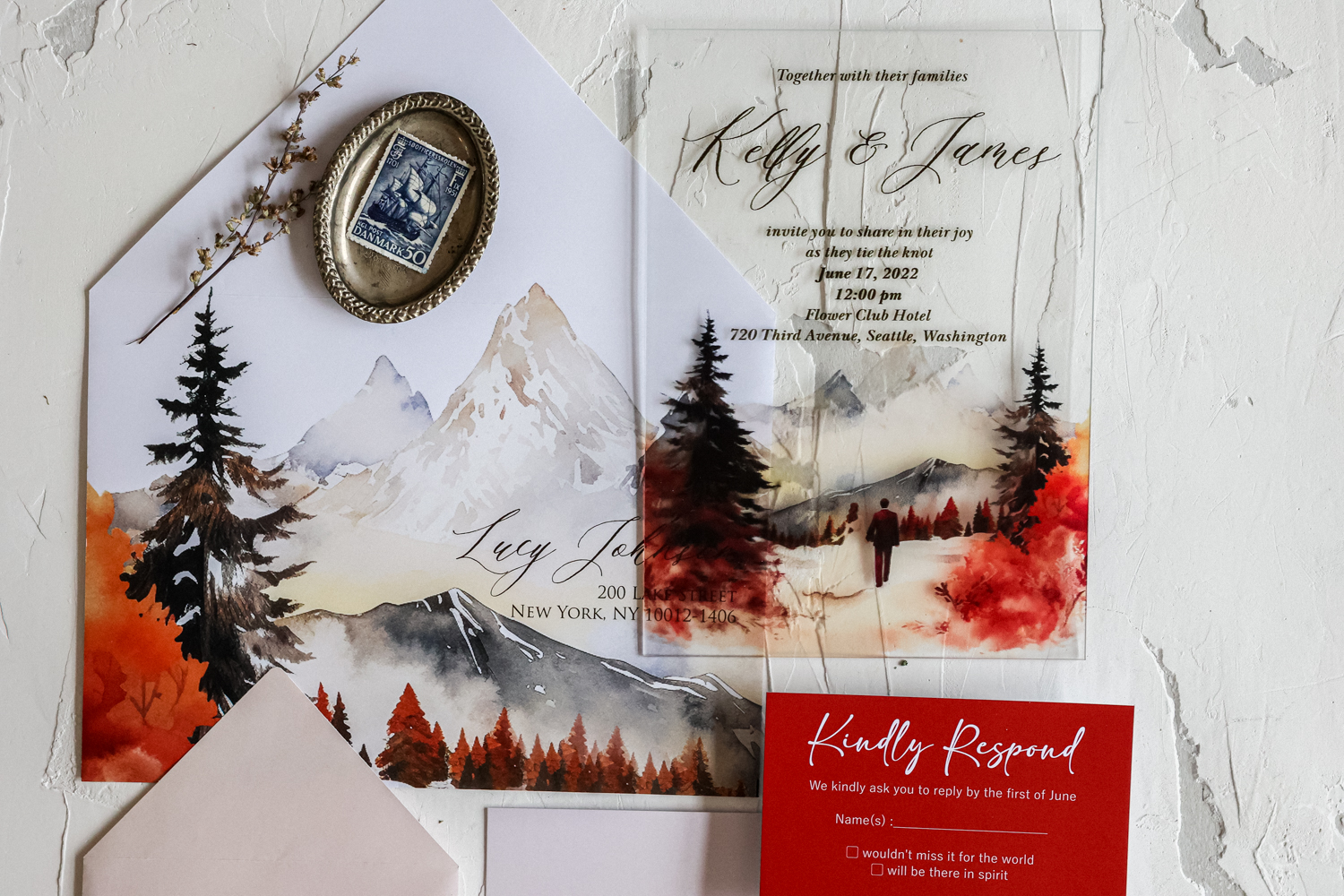
When planning a wedding, sooner or later you will face the choice of wedding invitations for your guests. The price range can be enormous – from just a few pounds per piece to dozens (and in exceptional cases, even hundreds) for a single invitation. Where do these differences come from? The cost of wedding invitations is influenced by several key factors:
- Chosen Style and Design – The more elaborate and complex the patterns, the higher the price. Simple, minimalist cards will be more affordable than invitations with rich embellishments or unusual shapes. A custom-made (bespoke) design also significantly increases the cost.
- Materials and Print Quality – The type of paper and printing technique are crucial price drivers. Digitally printed invitations on standard cardstock are relatively inexpensive, while materials like cotton paper, vellum, or acrylic plexiglass, combined with techniques such as letterpress or foil stamping, drive the price up. It’s no coincidence that eco-friendly or rustic invitations (made from simple, natural materials) often cost less than those on shimmering, luxury papers with added glitter or gold leaf.
- Additional Elements – Every extra means an additional expense. Inserts (e.g., RSVP cards, directions, gift poems), decorative envelopes, wax seals, ribbons, lace, crystals, or other decorations – all of these add up to the final price. The more elements in the stationery suite, the more expensive it becomes. For example, pocketfold invitations housing several separate cards will be more costly than a single double-sided card.
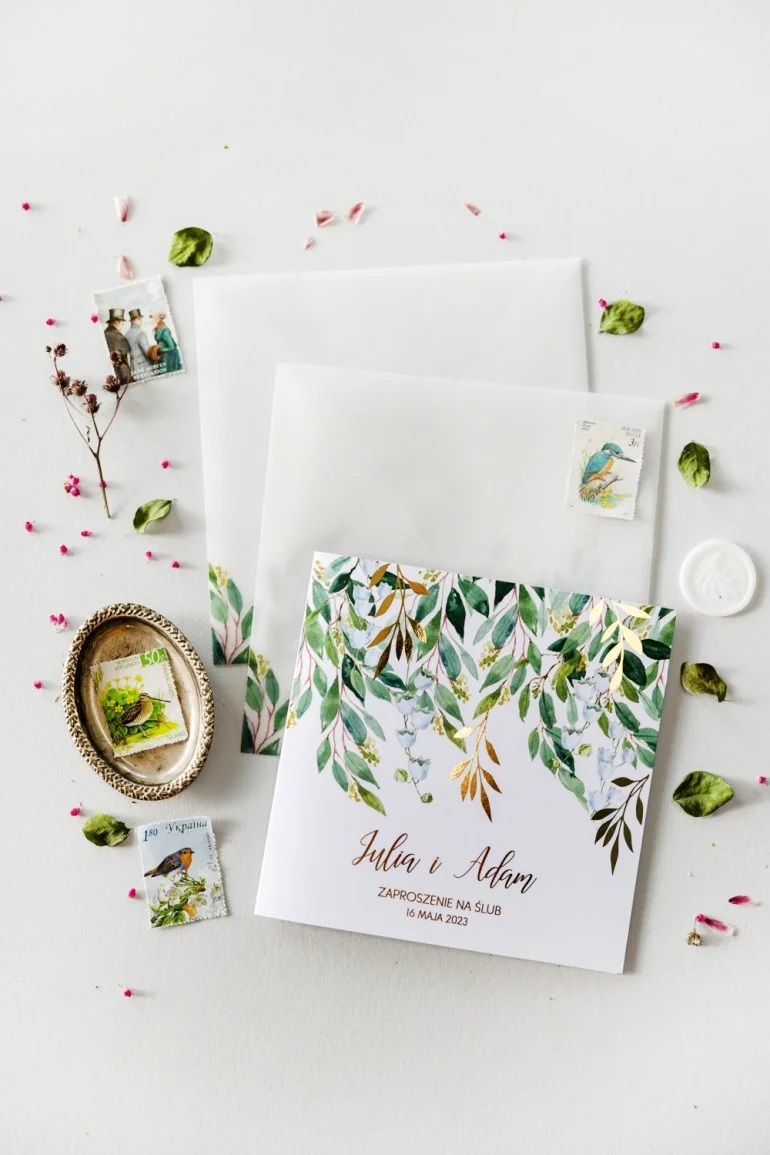
Wedding invitations with green leaves motif, gold accents, classic | Gold-foiled wedding invitations | Rubin no. 4
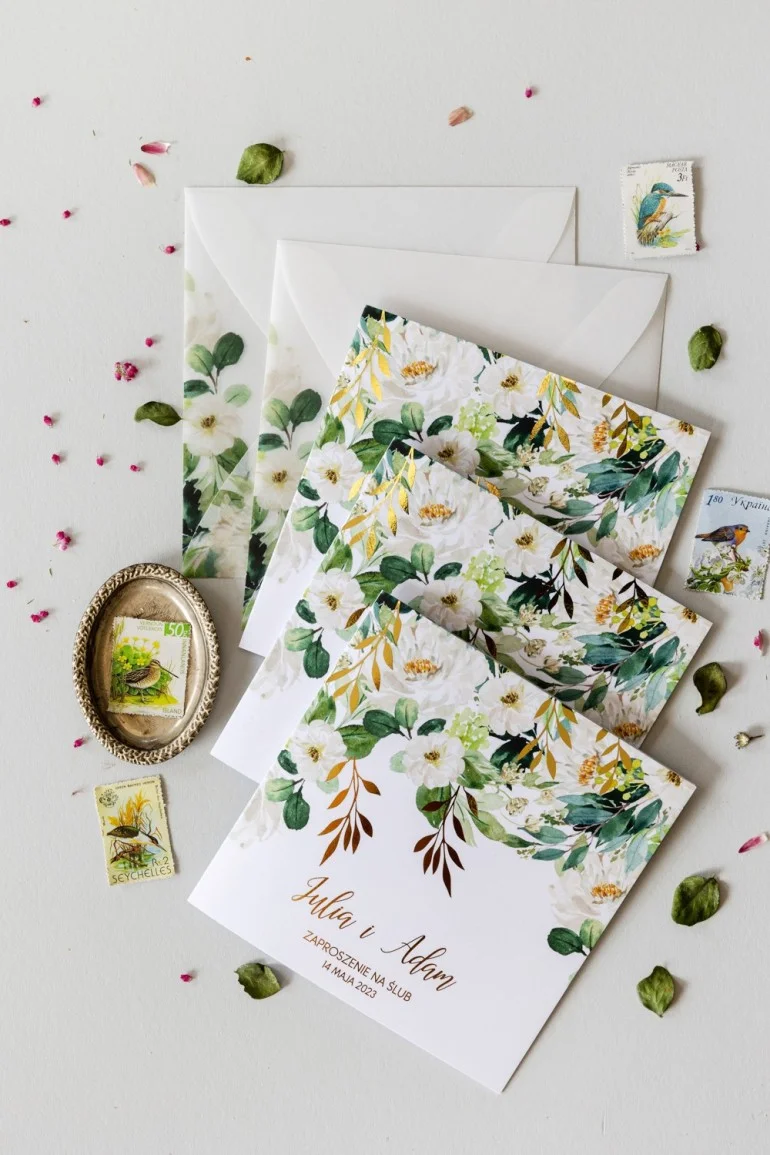
Stylish Wedding Invitations with Gold Accents, Watercolor Flowers | Exclusive Wedding Invitations | Rubin no. 1
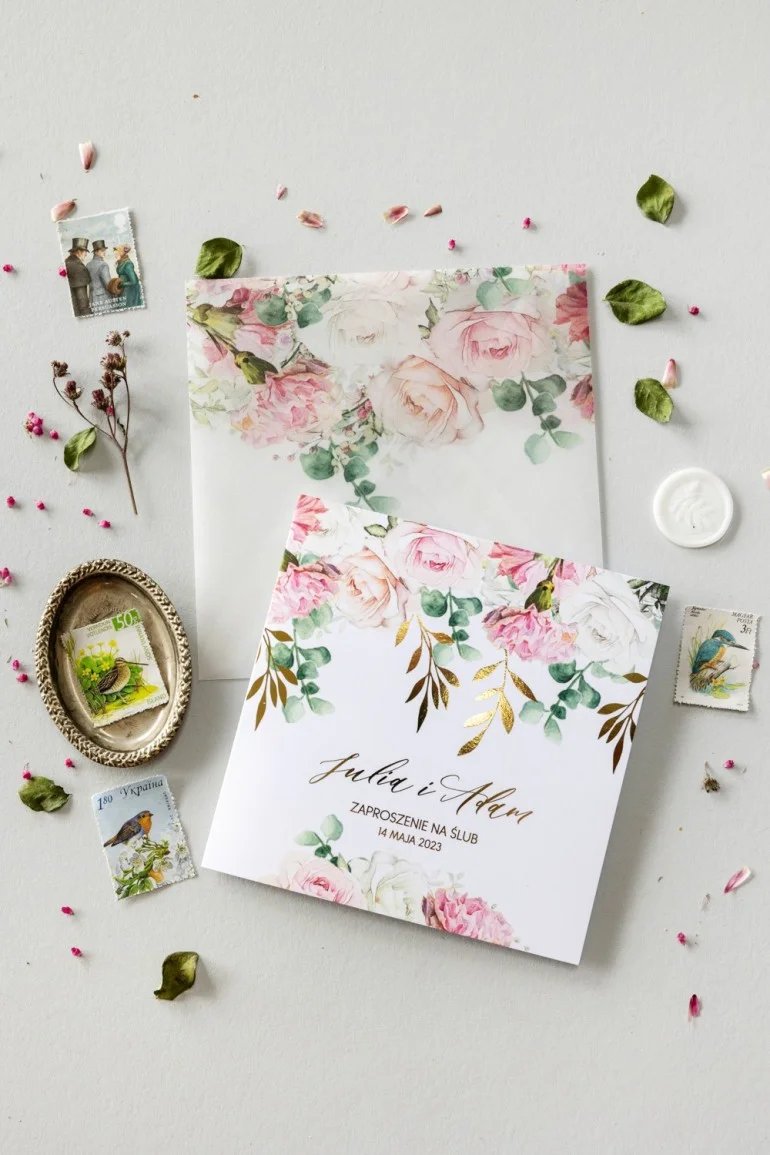
Wedding invitations with pink roses and gold foiling, transparent envelope | glamour style wedding invitations | Rubin no. 9
- Personalization – Typically, the price includes printing a fixed text (e.g., standard invitation wording with space to hand-write guest names). Full personalization, meaning printing the first and last names of all guests, is often an optional extra. Many companies charge a fee per personalized invitation or a flat rate for setting up the personalized digital file. Similarly, personalized envelopes (with guest names or decorative addressing) will increase the total cost.
. - Order Volume (Quantity) – The economy of scale also plays a role. With larger orders, you can often count on discounts – the unit price of an invitation may decrease as the number of ordered pieces increases. When ordering, for example, 150–200 pieces, it's worth asking the supplier about price negotiations for the set. However, be aware: if you only need a dozen or so invitations (e.g., for an intimate wedding), the unit cost may be higher due to minimum order thresholds or setup costs spread over a small number of copies.
Table of Contents
In practice, the average cost of a wedding invitation typically ranges from approx. £1.50 to £5.00 per piece. Much depends on the aforementioned factors – a typical offer from invitation companies focuses on the £2.00–£3.50 range, though you will certainly find both cheaper budget options and exclusive designs for much higher amounts. To illustrate: 100 invitations at £1.50 each is an expense of £150, while 100 invitations at £4.00 each is £400 – more than double for the same volume of cards. Across the entire wedding budget, a difference of a few pounds per invitation can translate into savings or additional costs of several hundred pounds (depending on the guest count). It is therefore worth exploring the available options – from budget-friendly ready-mades to luxury premium invitations – and consciously choosing the best solution for your style and budget.
Budget Wedding Invitations – Costs and Features?
Not every couple wants or can allocate a significant sum to stationery. Fortunately, there is a huge selection of affordable wedding stationery on the market, and budget wedding invitations can be both beautiful and inexpensive. Economy wedding invitations usually fall within the range of £0.50 to £2.50 per piece. What can you expect at this price?
-
Simple Designs and Standard Materials – Most of the cheapest invitations are relatively simple cards: often single-sheet or classic gatefold, made from thin or medium-weight cardstock. Ready-made designs available off-the-shelf in stationery shops or online marketplaces dominate this category. The graphics tend to be universal – e.g., flowers, rings, doves – and personalization is limited to printing your own details. These types of invitations are often sold in sets (e.g., a pack of 25) or individually without minimum quantities, allowing you to buy extra copies easily. Their design is usually quite versatile, often classic and elegant in its simplicity – a big plus, as simple styles are timeless and match everything. Many rustic or eco-friendly invitations also fall into the lower price bracket, using natural, cheaper materials (like kraft paper, jute twine) instead of expensive embellishments. As a result, rustic invitations with nature motifs can look impressive while costing less than heavily decorated glamour cards.
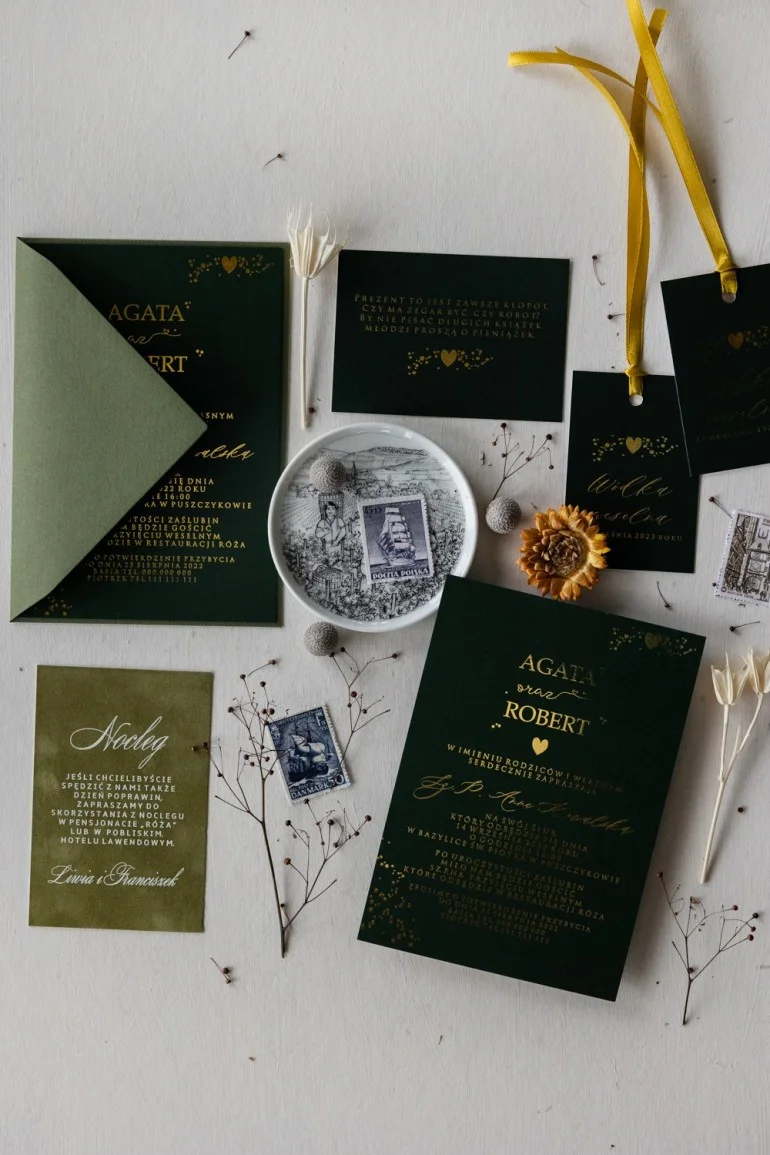
Single-card Wedding Invitation with gold foiling | Simple no. 2
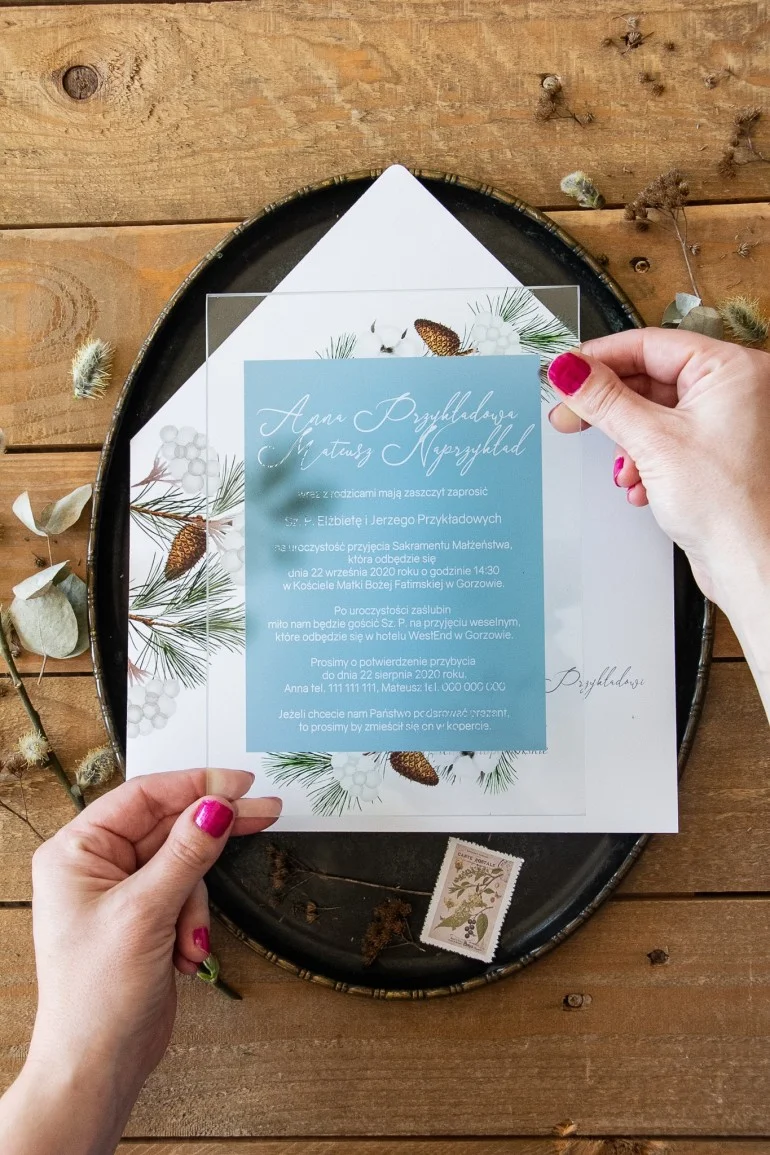
Extravagant Glass Wedding Invitations | Glassy Winter Accent | Cotton & Pine | Korani no. 8
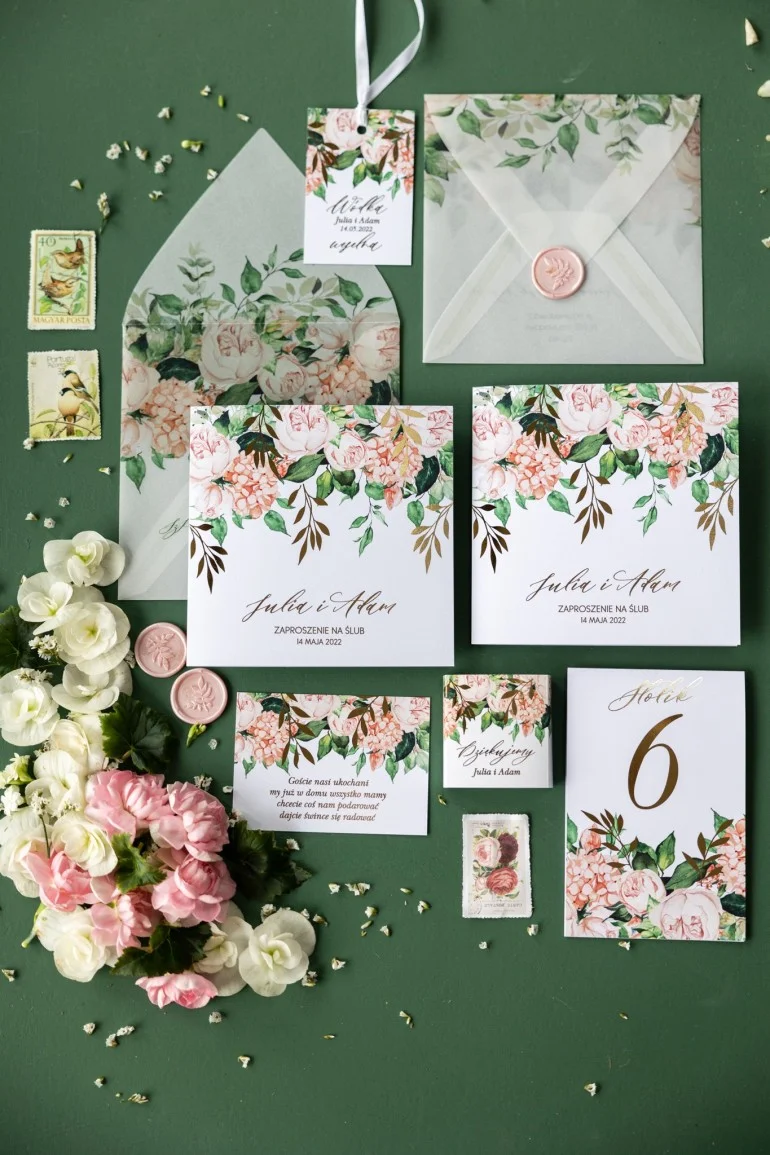
Unique Wedding Invitation with Gold Foiling, Pink Peonies and Vellum Envelope | Unusual Wedding Invitations | Rubin no. 10
-
Limited Personalization – Cheap, mass-produced invitations usually do not offer many options for personalizing content or appearance. Often, the invitation text is pre-set (with a few templates to choose from), and the couple can only add their names, date, and venue. Guest names in the most affordable options are typically handwritten – the invitations arrive with a dotted line or a blank space for manual completion. For some, this is a downside (requires extra work and neat handwriting), for others a plus – writing names by hand adds a personal touch and costs nothing. Alternatively, some companies offer guest name printing for an extra fee – it's worth checking if the invitation price includes personalization or if you have to pay extra. Sometimes an invitation costing e.g., £0.50/pc is "blank" (for self-filling), and if you want the seller to print the text and names, the price might rise to £1.00. Therefore, always read descriptions and ask about the scope of the service – a cheaper offer may turn out to be more expensive once hidden costs are added (envelopes, personalization, design, etc.).
-
Quality of Craftsmanship – It must be said honestly that invitations from the lowest price bracket may be inferior in quality to more expensive ones. Differences can be seen in paper thickness and texture (cheaper tends to be thinner, less rigid), print quality (cheaper invitations are sometimes printed on home printers or lower-end machines, affecting sharpness or color saturation), or precision (e.g., less precise cuts or folding). However, this doesn't mean all cheap invitations are poor. Many manufacturers offer very decent quality invitations for just a few pounds, benefiting from economies of scale and repeatable patterns. As industry experts point out, often a small difference in price can yield a significantly better visual effect – better paper and high-resolution printing will make even a simple design look elegant. Therefore, instead of choosing the cheapest possible offer (e.g., £0.30 per piece), it's worth looking for invitations that are "affordable but good". On the market, there are plenty of beautiful designs in the £1.00–£2.00 range – you will find classic motifs as well as currently trendy boho, greenery, and minimalist styles. For example, a simple single-card invitation with nice floral graphics can cost £1.00, and you can add a personal touch like a ribbon or jute twine yourself, which increases aesthetic value at a low cost.
-
What's Included in the Price? – When buying cheap invitations, pay attention to whether the envelope is included. Often, ultra-cheap offers apply to the card alone, without an envelope – which must be purchased separately. A plain white envelope costs ~£0.10–£0.20/pc, while colored or decorative ones are £0.50–£1.00/pc, and printed or personalized envelopes even more. If the offer looks tempting (e.g., 100 invitations for £50), make sure envelopes and any decoration are included. Another issue is the invitation design – can you choose fonts, text, and will you receive a digital proof for approval before printing? Good companies, even with cheap invitations, offer design and potential corrections for free within the set price, so the customer receives a product ready to be handed out. In summary: budget invitations are a great option for couples with a limited budget. For a few pounds per piece, you can get aesthetic, classic cards that do the job. You just need to choose consciously – read descriptions, compare offers, and estimate the total cost (including envelopes, personalization, and extras). This way, affordable wedding invitations can please the eye without ruining your wedding finances.

Impresja No. 10 Wedding Invitation – Eucalyptus and Gold Foil

Minimalist Wedding Invitation Pattern No. 3 – Lavender and Gold

Lauren No. 4 Wedding Invitation – Boho Style with Camel Envelope
Premium Wedding Invitations – Is it Worth Paying More?
On the other side of the spectrum are premium wedding invitations, exclusive designs for the most demanding couples. They often impress with intricate craftsmanship, unusual materials, and luxury finishes. The price of such high-end invitations can start from £8.00 per piece upwards, and in extreme cases reach dozens or even hundreds of pounds for a single invitation. Of course, such expensive individual pieces are relatively rare – many companies offer “luxury” invitations in the £4.00–£10.00 range. For example, an invitation made on transparent plexiglass with gold foiling and a velvet envelope might cost around £5.00–£7.00 per piece, which is high compared to budget options but not astronomical. What distinguishes premium invitations and what exactly are you paying more for?
Features of Premium Invitations:
-
Highest Quality Materials – Luxury invitations are often created on exceptional materials: ultra-thick, heavy cardstock (e.g., 700gsm cotton paper), elegant textured, metallic, or pearlescent papers, and even unusual substrates like plexiglass (acrylic), wood, fabric, or glass. Popular choices include acrylic invitations – clear, rigid sheets with engraving or printing – and invitations in wooden boxes. The latter are often offered as special invitations for parents – presented on wood or in a decorative box, serving as a lasting keepsake, which justifies the higher price. Premium materials are inherently more expensive but provide an incredible "wow" factor.
-
Advanced Embellishment Techniques – What sets exclusive invitations apart is often the labor-intensive printing and decoration methods. Instead of standard digital printing, techniques such as letterpress (relief printing with indented text), hot-stamping (foil gold or silvering), thermography, laser cutting, engraving (on wood or acrylic), and even 3D printing or wax sealing with a custom crest are used. These techniques require specialized machinery and often more manual labor, significantly increasing production costs. For example, hand-finished laser-cut lace patterns add extraordinary charm but raise the price – often laser-cut invitations cost around £3.00–£5.00/pc or more, whereas a similar design without the cutouts would be cheaper. Gold-foiled lettering or embossed monograms are other typical premium details – immediately associated with luxury and elegance.
-
Rich Form and Assembly – Luxury invitations are rarely just a single card in an envelope. They are often entire suites in decorative packaging. For example, an invitation might take the form of a box tied with a ribbon, containing the actual text on decorative paper. Pocketfold folders with pockets for extra inserts (map, RSVP, gift list) are also popular – all elements consistently designed and printed on the same exclusive paper. Premium envelopes may be decorated inside with a colorful liner made of velvet or decorative paper, and feature personalized printing or a wax seal. The whole set gives the impression of top-tier stationery.
-
Full Personalization and Unique Design – The price of high-end invitations usually includes graphic design services. The couple can consult on design details, matching every element to their requirements: fonts, colors, layout, or even order a completely bespoke design from scratch. Often, companies offering premium stationery allow for multiple revisions, advise on wording, and even propose personalized elements for each guest. Naturally, such a one-of-a-kind approach requires designer time, test prints, and consultations – all factored into the price. Consequently, premium invitations are unique and perfectly tailored to the character of your wedding. Guests often treat them like small works of art, and some will certainly keep them as a memento of the beautifully crafted cards.

Aurum No. 1 Wedding Place Cards – Purple Freesia and Peony Floral Table Cards

Glamour Wedding Place Cards No. 1 – Satin Name Cards with White Print

Avril No. 10 Wedding Place Cards – Gilded Glamour Table Name Cards
The question remains: is it worth paying more for premium wedding invitations? Ultimately, the answer depends on the priorities and budget of the specific couple. Consider a few points:
-
Overall Budget vs. Priorities – If your wedding budget is tight, spending several hundred or a few thousand pounds on invitations alone may not be wise. Remember that invitations are just one of many elements – there are outfits, photography, flowers, venue, catering, wedding favors, etc. However, if you have the funds and want your stationery to be dazzling, you can treat invitations as an investment in the first "wow" effect for your guests. For some couples, invitation design is so important that they prefer to cut back on other things to afford their dream cards.
-
Guest Count – It’s worth calculating the cost in the context of the wedding scale. For a small, exclusive gathering (e.g., 20–30 invitations), choosing very expensive invitations won't strain the budget as much as for a wedding with 200 guests. The cost of 30 invitations at £8 is £240, while 150 invitations at £8 is £1,200. If you have a large guest list, expensive invitations become a significant expense, and it might be better to consider a compromise – e.g., mid-range invitations that look elegant but don't cost a fortune.
-
Effect on Guests – There's no denying that beautiful, luxury invitations make an impression. Upon receiving a thick envelope with a shimmering monogram or opening a box with an invitation, guests will immediately feel the special character of your wedding. The invitation is a preview of the celebration – an exclusive form signals to guests that a lavish, detailed reception awaits them. If you are planning an elegant wedding in a palace or a 5* hotel, it's worth ensuring the stationery is consistent with that vision. On the other hand, most guests will likely eventually discard the invitation. That's why some newlyweds believe there's no point in overpaying – the content and conveying the information are more important, and the form can be modest but tasteful. Remember that even cheaper invitations can look very good and stylish if they align with the wedding theme and are aesthetically made.
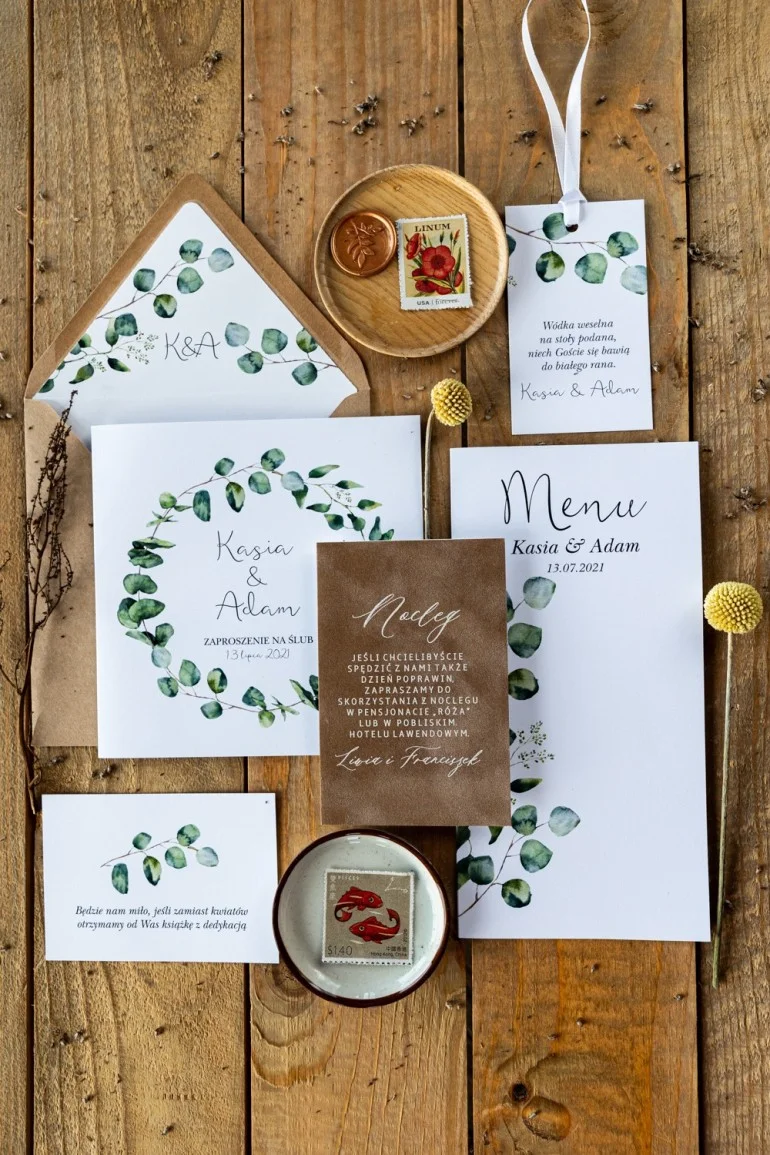
Eco-friendly Invitation with Greenery Styling | Wedding Invitations in eco envelope | Kalia no. 2
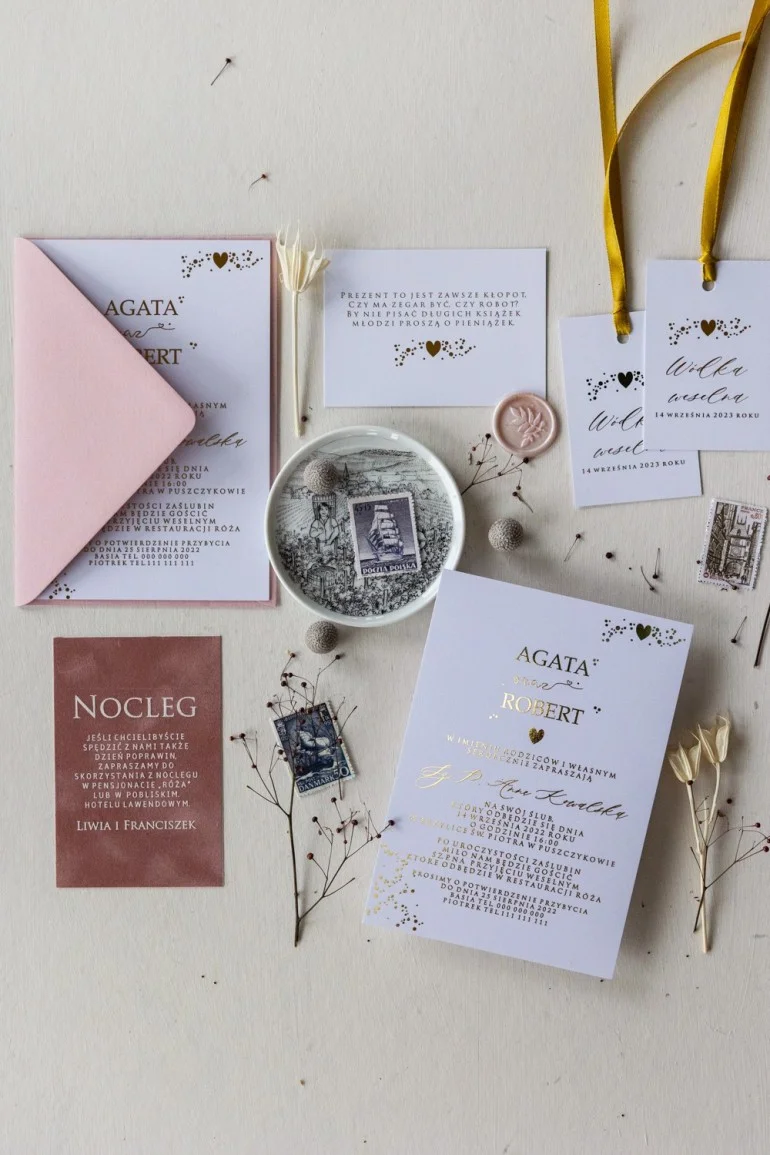
Subtle Wedding Invitations, Minimalist Design with Gold Elements | Simple no. 3
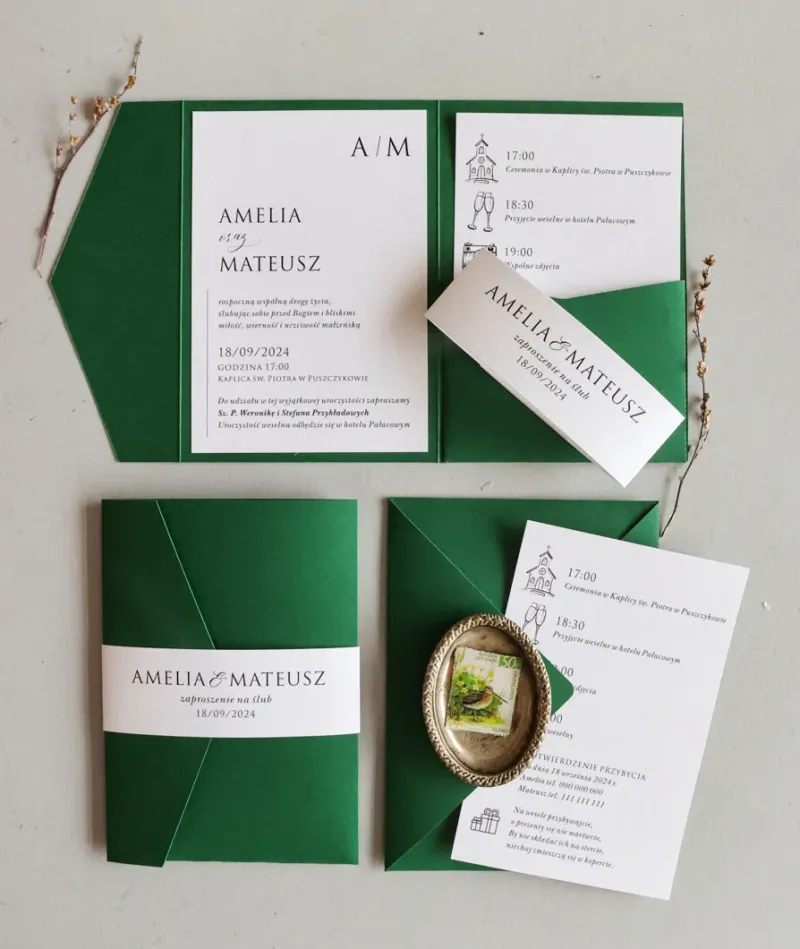
Elegant Wedding Invitations in Bottle Green Shades | Minimalist Design and Modernity | Kraft no. 10
-
The Golden Mean – A solution can be to find a compromise. You can, for example, choose mid-range invitations (say £2.50–£4.50/pc), which offer good paper quality and nice design without breaking the bank. Often you can also mix and match elements: e.g., order simpler invitations but buy impressive wax seals for the envelopes, or use a gold-foiled monogram sticker – such additions add prestige to affordable cards. Another idea is to order a few pieces of very exclusive invitations – for example, for immediate family (parents, grandparents, witnesses) – as keepsakes, while giving other guests a cheaper version with a similar motif. Some couples do this to honor VIPs with something extra without multiplying costs for the whole batch. There is also the option of off-season promotions – many stationery companies offer discounts on luxury models in winter or late autumn, allowing you to buy premium invitations at standard prices. As you can see, there are many ways to have beautiful invitations and not overpay.
In summary, premium wedding invitations are a choice for those who value the highest quality and refined details, where budget is not the primary constraint. They provide a spectacular effect and elevate the event's status from the start. However, the most expensive isn't always the "best" – the best will be what meets your aesthetic expectations and fits within your set budget. Sometimes a cheaper invitation with a small upgrade (nicer envelope, liner, or a hand-added accent) can look just as beautiful as a very costly counterpart.
Handmade vs. Ready-made Invitations – Which is More Cost-effective?
In the era of DIY trends, many engaged couples ask themselves: should we make our wedding invitations by hand? Or conversely – is it worth commissioning an artist for handmade stationery instead of buying ready-made? Let's compare handmade vs. ready-made invitations in terms of cost and value.
Handmade invitations is a broad term. It can mean DIY invitations made by the couple themselves, as well as hand-crafted invitations made to order by artists or artisans (e.g., watercolor painted, hand-calligraphed, etc.). Each of these options has different pros, cons, and costs.

Soy Candle Rubin No. 1 – Foiled with Flowers and Wedding Favours

Golden Fortune Cookies with Personalized Label | Affordable Wedding Favours | Cejla No. 3

Simple No. 3 Soy Candle – Gold Foiling & Elegant Wedding Favours
DIY – Savings or a Trap?
Making invitations yourself is tempting primarily due to potential savings. As experts emphasize, DIY is not only a way to save money but also an opportunity to express creativity and add a personal touch. Here is what to consider:
-
Material Costs: Basic materials (cardstock, ink/toner, envelopes, decorations like ribbons, lace, glue) can be inexpensive, especially if bought in bulk. For example, a ream of thick paper can yield hundreds of invitation cards. Add the cost of printing – if you have a good printer, you can print yourself, or outsource to a digital print shop. In total, a DIY invitation can cost as little as £0.50–£1.00 per piece in materials – a highly competitive price. Moreover, unused materials can be repurposed for other DIY wedding decorations.
-
Tools and Time: With DIY, you must factor in your time and effort. Making 100 invitations by hand involves dozens of hours: designing, printing, cutting, folding, decorating... For artistic people, this is a pleasure, but for others – a source of stress. If you lack experience, the first few copies might fail, leading to material waste. Ask yourself how much your time is worth and if you'll have time for craft evenings during the wedding rush. Also, consider the cost of tools: a good paper trimmer, decorative punches, stamps, or a hot glue gun. Despite this, for many, DIY is a form of relaxation and fun – a chance to spend time together creating something unique.
-
Effect and Quality: Handmade invitations have undeniable charm – they are unique and personal. Guests will appreciate that each card was made specifically for them. On the other hand, if you want a professional finish, assess your skills. Without practice, DIY can look amateurish – uneven cuts or smudged prints can ruin the look. A good practice is to make a few prototypes. You can also opt for partial DIY – e.g., order semi-finished products: ready-made blank invitation bases and envelopes, and add decorative elements yourself. This is a compromise between full DIY and a ready product.
When is DIY worth it? Certainly when you have the time, basic manual skills, and want to save money while adding something special. For small weddings (20-30 invitations), DIY is very manageable. For larger weddings (100+), you need to plan well or enlist help. Cost-wise, DIY is almost always cheaper than buying premium invitations, but the question is whether the money saved compensates for the time and energy required. It's also wise to prepare a few spare pieces for mistakes or extra guests.

Cejla No. 3 Soy Candle in Plaster – Eucalyptus & White Flowers Favour

Cejla No. 6 Soy Candle in Gypsum – Gilded Eucalyptus Wedding Favours

Cejla No. 10 Soy Wax Candle in Plaster – Botanical Wedding Favour
Handmade to Order vs. Ready-made
If you lack artistic talent or time but love handcrafted techniques (calligraphy, watercolors, hand-painted gilding), you can commission an artist. Such bespoke handmade items are truly premium invitations – you pay for manual labor and skill. Is it worth it?
-
Price of Handmade Artist Invitations: Varies depending on the creator's reputation and technique. However, hand-decorated invitations are more expensive than machine-printed equivalents due to the time involved. You might find simple hand-assembled cards for approx. £3.00–£6.00/pc, but complex projects can cost much more. Uniqueness always comes at a price – you pay for the artist's time.
-
Advantages of Artisan Invitations: You get a one-of-a-kind product – no machine can replace certain handwork effects. Calligraphed names, watercolor illustrations – these make invitations small works of art. The quality is often phenomenal as artisans put their heart into every piece. The downside is the lead time – handmade production can take weeks or months, so order well in advance.
-
Ready-made Invitations: These are digitally designed and mass-printed. Their advantage is speed and price. If the wedding is approaching and you don't have 2 months for hand-painting – you choose a catalog design and often receive the pack within 7-14 days. The unit cost is lower because you pay for materials and printing, not time-consuming hand-decoration. As mentioned, the average price is around £2.00–£3.50/pc. You get a high-quality but reproducible product.
Which is more cost-effective? Strictly in financial terms, buying ready-made invitations usually wins over bespoke handmade. Mass production is simply cheaper. However, DIY can be the cheapest option of all, though it "costs" significant time. Compare savings vs. effort. You can order samples of ready-made ones and make a DIY prototype to see what suits you best. Sometimes combining methods is best – buy affordable ready-made invitations and add a handmade accent like dried flowers or a hand-calligraphed name.
Ultimately, handmade vs. ready-made is a choice between time and money, and uniqueness and convenience. DIY invitations pay off when you want to cut costs and have the creative spark. Ready-made invitations save time and stress, and their cost can be optimized. Handmade to order is for those who value artistry and are willing to pay for it.
How to Save on Wedding Invitations? Practical Tips
Regardless of the type of invitations you choose, most couples look for ways to cut costs. Here are practical tips to help you save on wedding invitations without sacrificing style:
-
Order slightly more, right away – Paradoxically, to avoid overpaying, order 5–10% more invitations than your guest list suggests. Why? If you need extra pieces last minute, reprinting a small quantity is expensive due to setup fees. Spare invitations protect you from paying high premiums for a small reprint.
-
Simplicity over excess – When budget matters, opt for classic moderation. Avoid invitations packed with extras: every ribbon, rhinestone, or layer of lace adds to the cost. Beauty lies in simplicity – an elegant design on good paper often looks more stylish than over-complicated decorations. If you want some sparkle, choose one finish (e.g., gold foiling) but skip other costly additions.
-
Standard Format and Size – Elaborate sizes or unusual shapes can generate higher printing costs and envelope issues. Standard A6 or A5 invitations easily fit into ready-made envelopes available cheaply. Non-standard formats often require custom envelopes. Moreover, unusual sizes can increase postage costs.
-
Skip Unnecessary Inserts – Separate cards for RSVP, accommodation, or maps are common. Consider if you really need to print all these inserts. A great alternative is creating a wedding website and putting all extra info there. Then, just add a small note to the invitation: "Details at our website: ________". You'll save on printing multiple cards per invitation.
-
Write Guest Names by Hand – As mentioned, invitation personalization (printing guest names) is often an extra charge. To save – buy invitations without personalization (blank for filling) and write them yourself. In the digital age, handwriting is seen as more personal and elegant. If you have neat handwriting or a talented friend, ask for help. You'll save a significant amount.
-
Compare Offers and Hunt for Sales – The market is large, so search several sources before deciding. Check what the price includes (design, envelopes, proofs). Take advantage of seasonal discounts – many companies offer deals at wedding fairs or off-season sales. For example, on Amelia-Wedding.pl, there are often promotions on wedding invitations and wedding favors. Ordering in advance gives you a chance to catch sales and buy a premium model at a standard price.
-
Choose the Number of Invitations Wisely – Analyze your guest list carefully. Remember, you usually send one invitation per couple/family, so the number of invitations is lower than the guest count. Optimizing the quantity is a direct saving.
Saving on invitations doesn't mean they have to be low quality. With a bit of cleverness, you can have beautiful invitations at a reasonable price. Often, changing a small detail can significantly lower the cost.
Also, remember stationery consistency – when ordering invitations, think about matching other items. It often pays to order a whole set from one company: invitations, menus, place cards, table numbers, table plans, or tags for wedding favors. This is often more cost-effective and ensures a unified style.
Wedding invitations are a key part of preparations – they set the tone for your wedding. However, they don't have to be a burden on the budget. By knowing the price realities and using smart solutions, you can achieve your dream effect without spending a fortune. We hope this analysis helps you make the best decision. Good luck with creating your perfect wedding stationery!
If the topic of wedding invitation costs was inspiring for you, be sure to check out other articles on our blog! You'll find more tips on planning your dream wedding. Below are a few texts that perfectly complement this article:
-
Guest List and Seating Arrangements – How to Create the Perfect Table Plan?
Learn how to handle the guest list and arrange tables so everyone feels comfortable. -
How to Create a Luxury Atmosphere on a Small Budget?
Discover clever ways to introduce a touch of prestige even when funds are limited. -
What Wording to Put on Wedding Invitations?
If you're wondering how to phrase your invitations, find inspiring suggestions here. -
How to Save on Your Wedding? 10 Proven Ways
(In case you want a comprehensive approach to wedding finances!) -
Bridesmaids and Groomsmen: Selection, Duties, and 2025 Trends
Don't forget the support of your loved ones. Check out the roles of the wedding party.
We hope these suggestions spark your imagination. Remember, more practical advice and inspiration await you on the Amelia Wedding blog. Happy reading and beautiful planning for your big day!
Szymon Jędrzejczak
Wedding industry expert and stationery designer at Amelia-Wedding.pl. For years, helping couples create unforgettable moments by combining tradition with modern design.