Relationships with future in-laws – building understanding and cooperation during wedding planning

Organizing a wedding is not only an exciting task for the engaged couple but also a true test for family relationships. In the heat of wedding preparations, it's easy for stress and misunderstandings to arise – especially between the future Bride and Groom and their future in-laws. How can you ensure that your partner's parents become your allies rather than a source of conflict? How do you build understanding and cooperation while planning this special day? Below, we present a comprehensive guide full of practical tips to ensure your wedding planning takes place in a family atmosphere, making the bond with your future in-laws stronger and more cordial. You will learn, among other things: how to involve future in-laws in preparations (from delegating tasks to joint decision-making), how to maintain your decision-making power and control over the wedding without hurting your partner's parents' feelings, how to handle conflict situations, and how to strengthen the bond with your new family through proper communication and empathy. We will also provide example dialogues and specific situations – so you can feel more confident in every conversation with your future mother-in-law and father-in-law. We invite you to read this guide, which will allow you – dear engaged couples – to look at relationships with future in-laws from a new perspective. Your wedding can become a shared, unifying experience for the whole family, rather than a battlefield. It all depends on your approach, goodwill, and a few proven communication methods described below.
Understanding the Perspective of Future In-Laws
The Significance of the Wedding for Parents and Generational Differences
For the engaged couple, the wedding day is primarily the fulfillment of their dreams and the beginning of a new stage in life. However, it's worth remembering that the wedding and reception are also incredibly important events for the parents of both sides. From their perspective, it's the moment they "give away" their child – it's no wonder that strong emotions often accompany this. The mother of the groom or bride may have been imagining this day for years and wanting everything to be "just right." The father, on the other hand, may feel pride but also a certain nostalgia. These feelings sometimes cause future in-laws to get more involved in wedding preparations than you might expect. Add to this generational differences – parents remember different realities of organizing a wedding, different trends, and customs. What is a modern idea for the young couple (e.g., a modest outdoor wedding or a non-standard menu) may seem like an eccentricity or a cause for concern about "what the family will say" to them. Conversely, traditions they consider obvious (like breaking glasses or the apron dance) might not hold much meaning for you. Realizing these differences is the first step – it's easier to be patient when we understand where our future in-laws' ideas and reactions come from.
Good Intentions vs. Interfering
Frustration often arises during engagement: "Your beloved's mother keeps putting her two cents in – doesn't she understand it's our wedding?". In such a situation, it's worth taking a step back and looking at the intentions. Usually, the future mother-in-law means well – she wants to help, share her experience, and protect you from mistakes. Her methods (e.g., firm advice or criticism of your ideas) may be difficult to accept, but the intention is often care, not malice. Similarly, the future father-in-law may voice strong opinions about the choice of venue or the guest list because he feels responsible for the family and wants to ensure everyone's comfort. This doesn't mean you should blindly follow all suggestions. It's about not immediately treating every comment as an attack. Try to distinguish overzealous interference from situations where parents actually have something valuable to share. Example: if your future mother-in-law insists on looking at one more wedding dress because "that one is too bold," she might be concerned about your comfort and the opinion of the extended family. You can calmly listen to the advice – and then do it your way anyway, while appreciating that she meant well. A kind "we know you want the best for us" works wonders. However, when you feel someone is clearly crossing boundaries (e.g., dictating who you must invite when it's your decision), then it's time for assertiveness – which we discuss further in this guide.
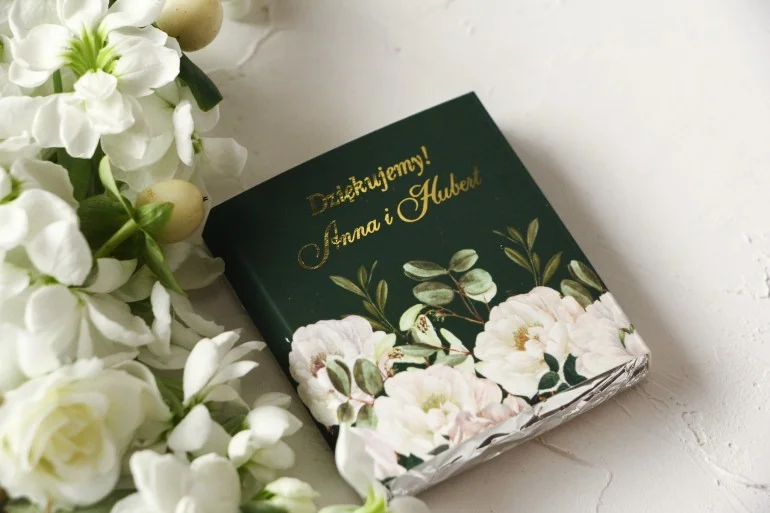
Wedding chocolates with a bouquet of white roses and eucalyptus | Szafirowe nr 3

Wedding honey with olive branches | Indygo nr 2
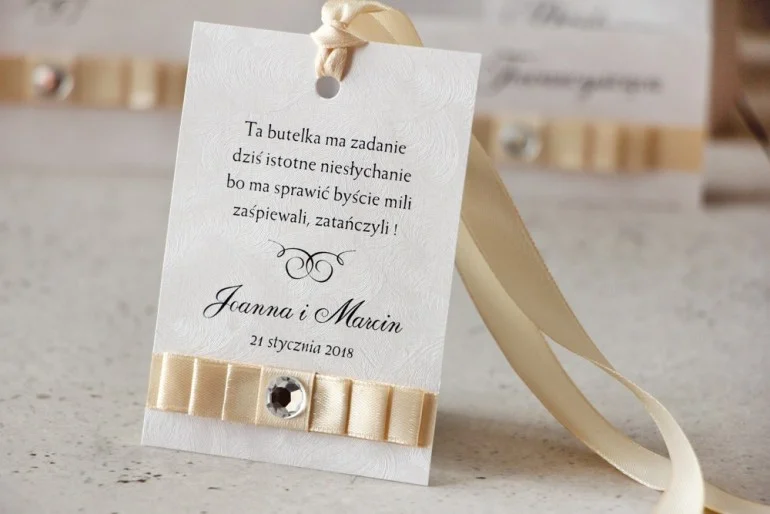
Elegant wedding vodka tags with zircons | Amaretto nr 1
Respect for Parents' Experience and Role
Building good relationships starts with showing respect. Your future in-laws have years of life experience – including organizing their own wedding or other family celebrations. Even if their taste or ideas seem old-fashioned to you, it's worth listening and showing interest. A simple conversation over coffee about what their wedding was like 20-30 years ago can be fascinating and help you understand their approach. You might discover that, for example, certain wedding traditions are particularly important in the groom's family – if they tell you about it, it will be easier for you to kindly uphold certain customs or consciously weave elements of those traditions into your ceremony. The parents, in turn, will feel proud and appreciated. We also show respect through language and manners. Try to address your future in-laws politely – even during moments of tension, the tone of the conversation changes a lot. Instead of "It's our business, please don't interfere," you could say: "We understand that you care about a successful wedding, and so do we. However, we want to organize it our way. Your advice is valuable, but we want to make the final decisions ourselves." Such a statement is firm but full of respect for their role. This way, the in-laws see that you take them seriously as part of the family, even though you have your own opinion. In summary – empathy and respect are the foundation for even starting to talk about cooperation in wedding planning.
Joint Planning – Setting Roles and Expectations at the Beginning
Table of Contents
- Understanding the Perspective of Future In-Laws
- Joint Planning – Setting Roles and Expectations at the Beginning
- Involving Future In-Laws in Wedding Preparations
- How to Maintain Decision-Making Without Hurting In-Laws' Feelings
- Effective Communication and Conflict Resolution
- Building Understanding and Strengthening Bonds with Future In-Laws
- Summary: Shared Goal, Shared Joy
Presenting Your Wedding Vision to Parents
The first step to harmonious cooperation is clear communication from the start. Before preparations get into full swing, it's worth sitting down with parents from both sides (together if possible) and presenting your vision for the wedding and reception. Tell them how you imagine the day: whether you dream of a grand wedding for 150 people or an intimate gathering; whether tradition is more important to you or if you're planning something unusual; what your ideas are for the ceremony (church or civil), decoration style, music, etc. Such an open conversation from the beginning will allow everyone to know what to expect. Future in-laws will gain confidence that their child is getting married on their own terms, not in a chaos of indecision – this commands respect. You, in turn, can catch potential points of contention early. For example, if you signal that you're planning an outdoor wedding and see panic in the eyes of conservative parents, you have the opportunity to calmly explain the reasons for this decision ("We've always dreamed of a garden ceremony; we feel it suits us better than a church. We know religious tradition is important to you – we're considering a short blessing before the ceremony to combine both options."). This way, parents feel you are taking them seriously and trying to find a balance, rather than presenting them with a fait accompli.
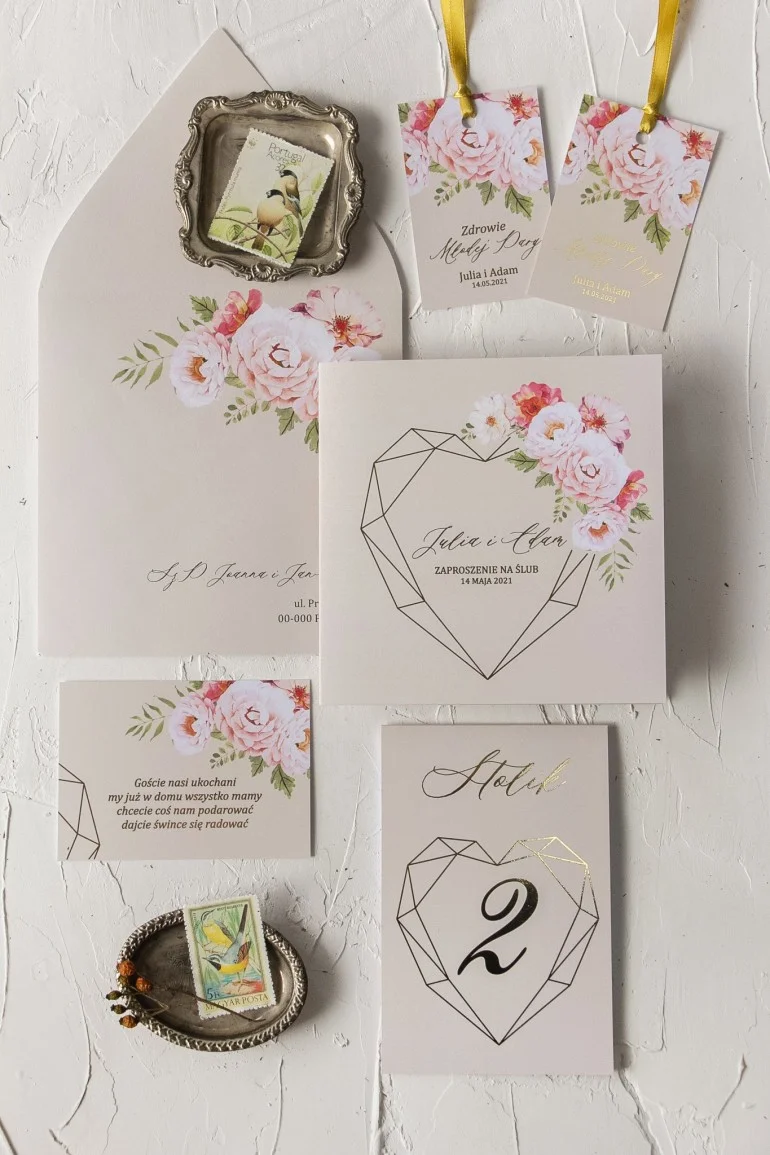
Wedding Invitations with Gold Heart and Floral Motif | Modern and Stylish | Szafirowe nr 8
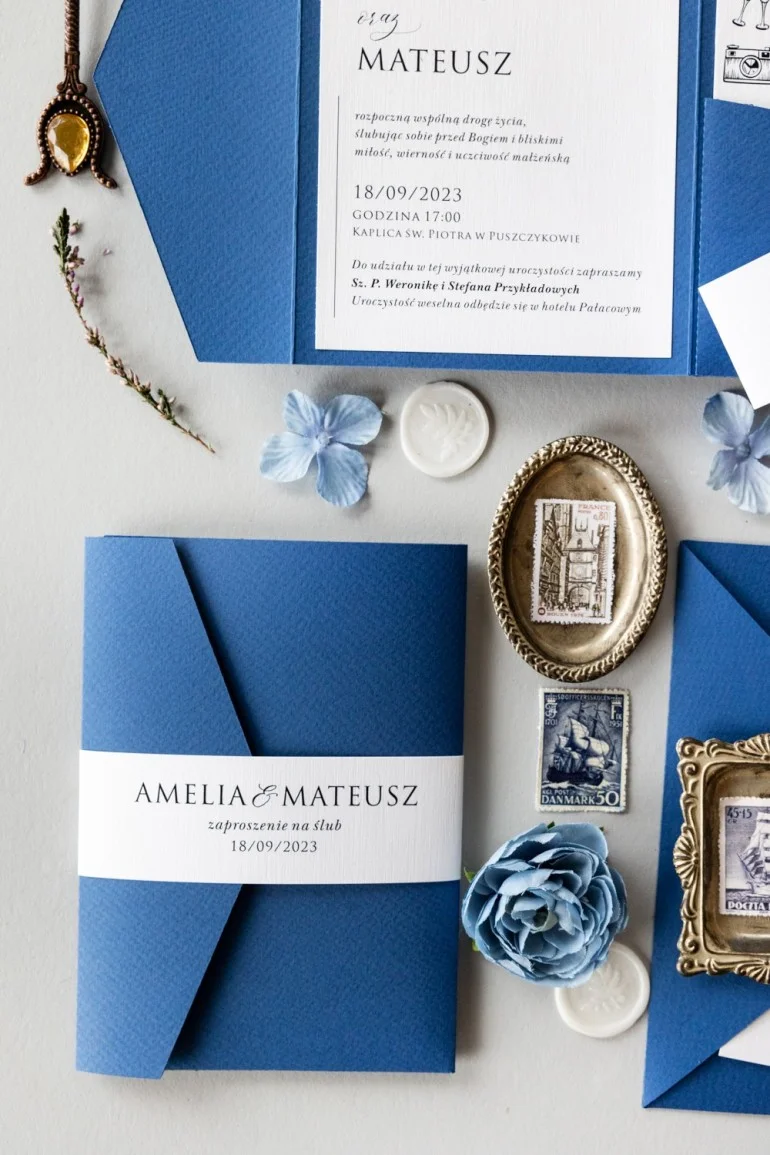
Blue, Elegant Wedding Invitation with Pocket and Personalization | Kraft nr 7

Wedding Invitations with Sunflowers and Gilding | Modern and Original | Rubin nr 7
Defining the Scope of Help from Parents
During initial talks, it's good to clearly establish roles and the scope of parents' involvement in preparations. Every family is different – in one, the Bride's mother has been saving money for her daughter's wedding for a long time and dreams of helping with everything; in another, parents say: "It's your project, we won't interfere, but let us know what you need." Ask your future in-laws (and your own parents) directly to what extent they would like and are able to participate in organizing the wedding. Are they offering financial support? (This is a common topic – if parents contribute to the budget, they will naturally want to have an influence on certain matters. We discuss how to balance this later). Do they have the time and desire to handle specific tasks? Or do they prefer to be just consultants, offering advice when you ask for it? Setting these expectations will prevent many misunderstandings. For example, if your future mother-in-law says from the start: "I'd love to take care of the cake and pastries, I have experience in choosing menus," then you already know you can confidently entrust this area to her (if it suits you). If the father-in-law notes that he is very busy with work and "can only help financially, leaving the rest to you," respect that and don't require him to participate in every meeting. This division of roles makes everyone feel needed according to their capabilities, and you – the Couple – maintain control over the whole, knowing who is doing what.
Establishing Rules for Decision-Making and Finances
A very important point to discuss with parents is the issue of decision-making, especially when their money is involved. Often, parents want to financially support their children in organizing the wedding – which is a beautiful gesture, but sometimes comes with an unspoken assumption of "I pay, so I decide." To avoid later disappointments on both sides, talk about this openly. Thank them for the offered help and simultaneously note that you treat it as a gift, not a payment for implementing someone else's scenario. You could put it this way: "Mom, Dad – we really appreciate that you want to help us finance the wedding. It means a lot to us. However, we want you to know that it's important to us that the celebration reflects our taste and dreams. Your opinions are important, but please, allow us to make the key decisions." In most cases, parents will understand this – perhaps they got married once themselves and remember how important their autonomy was. And what if one side, despite the conversation, still believes they should set conditions because they are paying? Then a firm but polite reminder can help: "We are grateful for the support, but this is our wedding and we want it to be our way. Thank you very much for the help – thanks to it we can realize our plans – but decisions regarding, for example, the choice of the band or the wedding menu will be made by the two of us." Don't worry that such an attitude will hurt the parents – if you maintain a kind tone, the in-laws will feel they have loving, albeit adult children who know what they want. It's better than suppressed frustration.
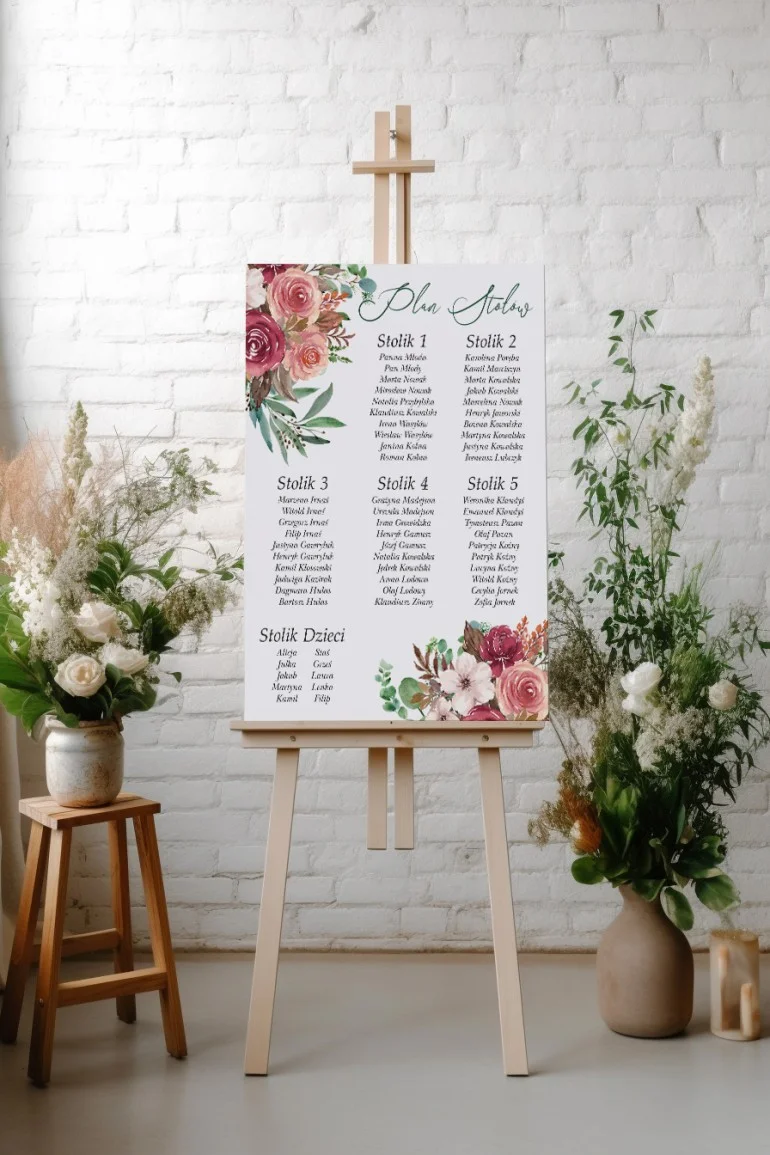
Wedding table plan Delize nr 3

Wedding table plan Eteryczne nr 2
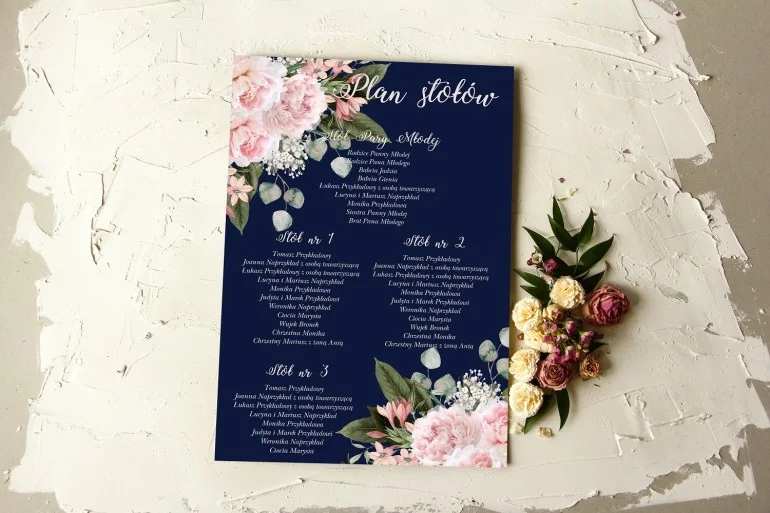
Wedding table plan Pastelowe nr 3
An Action Plan to Minimize Misunderstandings
It's worth writing down joint agreements or at least summarizing them in an email/messaging group so everyone is clear on the next steps. You can prepare an outline of the action plan: a list of the most important tasks for organizing the wedding (e.g., booking the date and venue, choosing catering, band/DJ, photographer, decorations, outfits, guest list, transport, etc.), and then mark who is involved in which stage. It's worth discussing such a plan together. For example: "We would like to choose and book the venue ourselves, as it's a key decision for us – but of course, we will present our choice to you. However, when choosing the menu, we'd love to use your experience – maybe we could go to the tasting at the venue together?". Or: "We'll choose the wedding music ourselves because we know our friends' tastes, but we ask for your help in finding a good folk band for the welcome at home – we know you have connections." This style of conversation – where you clearly communicate what you're taking on and where you see room for help – signals to parents that you have a plan. This is important because when in-laws see you are in control of the organization, it's easier for them to restrain the urge to control everything. They have designated areas where they can shine, which satisfies their need for participation. At the same time, you gain relative peace of mind that no one will suddenly start arranging things you'd rather handle yourselves. Of course, a plan is one thing – life often modifies it. However, even framework agreements will mean that when a dispute arises, you can refer back: "Mom, we agreed that decorations were our area. We appreciate your idea with those balloons, but we're sticking with our minimalist wedding decorations, okay?". Parents will then remember that they actually gave you a free hand in that topic. In short, clearly established rules at the beginning mean less chance of arguments in the middle of preparations.
Involving Future In-Laws in Wedding Preparations
Utilizing In-Laws' Talents and Passions
Everyone has certain strengths – including your future in-laws. Instead of looking at your partner's parents as potential critics, try to see them as allies with valuable talents. Is the Bride's mother a master of organization? Let her help coordinate deadlines with vendors. Does the Groom's father cook brilliantly or know about wines? Involve him in choosing the wedding menu and alcohol. If the future mother-in-law has an artistic sense and loves crafts, could she design small decorations or hand-make some of the ornaments? It's important to match tasks to predispositions – then parents will feel confident in their roles and perform their duties with engagement. For example: if the groom's mother-in-law (your future mother-in-law) loves plants and has a beautiful garden, she might happily take on the topic of flowers – helping to choose compositions, finding a florist, or even arranging bouquets for the tables herself. Someone in the family good with computers and graphics? They could prepare the design for an insert for wedding invitations or a commemorative photo presentation for the wedding. When future in-laws do something they enjoy and are competent at, they feel they are making a real contribution – instead of "interfering," they become part of the team organizing the celebration. Additionally, you feel relieved because certain matters are being handled. It's a bit like delegating tasks to colleagues at work – when everyone has their area, the whole thing goes more smoothly.

Wedding invitations with green leaves motif, gilded accents, classic | Gilded wedding invitations | Rubin nr 4
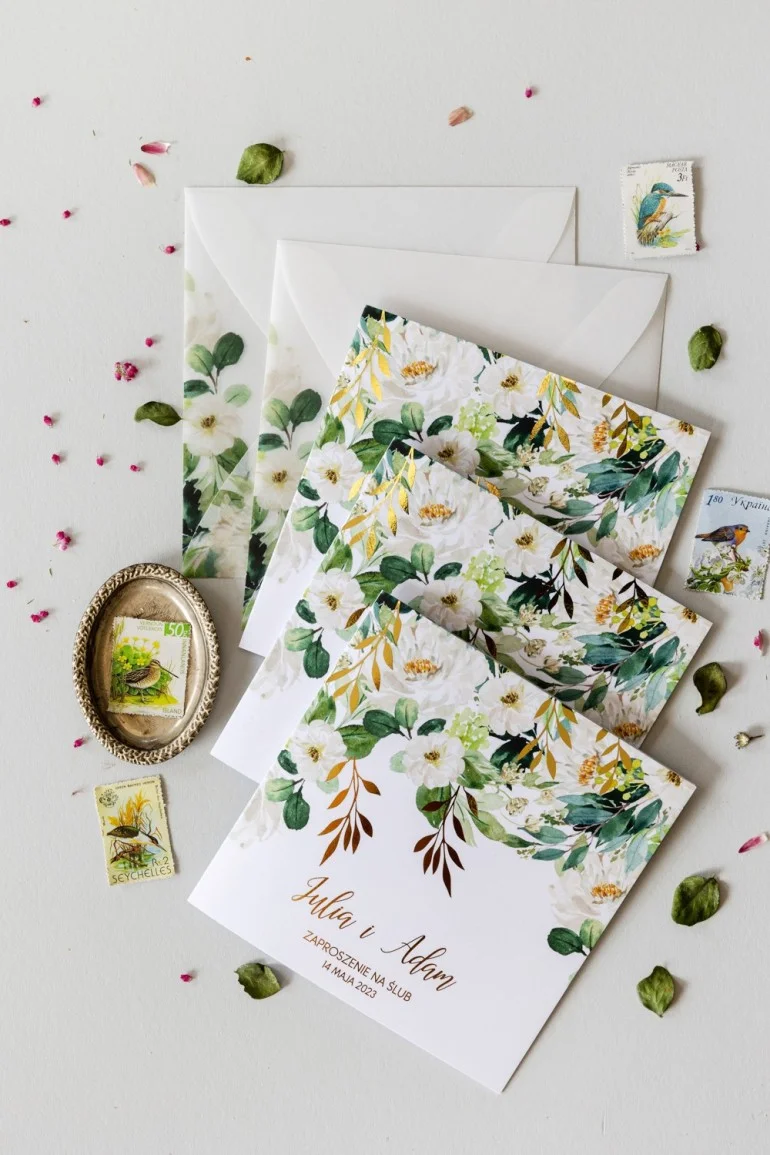
Stylish Wedding Invitations with Gold Accents, Watercolor Flowers | Exclusive Wedding Invitations | Rubin nr 1
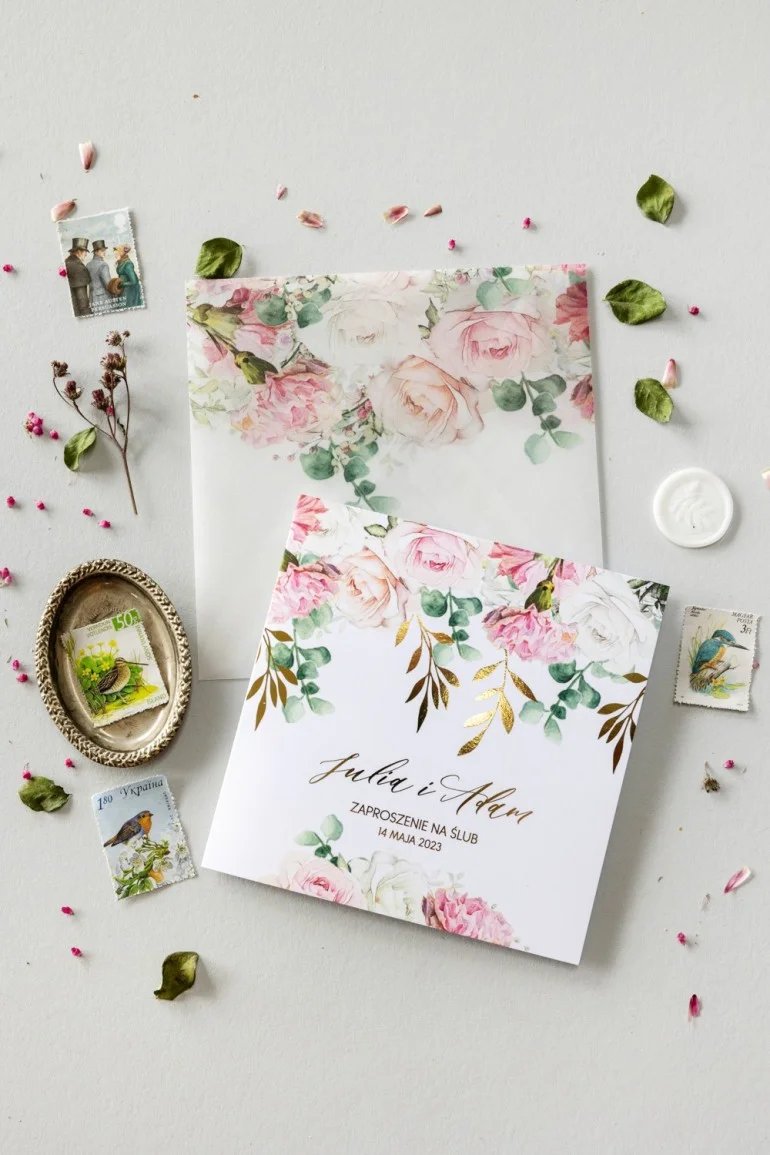
Wedding invitations with pink roses and gilding, transparent envelope | glamour style wedding invitations | Rubin nr 9
Delegating Specific Tasks and Responsibilities
When involving in-laws, it's worth delegating specific tasks so they know what is expected of them. A general "help us with preparations" might be too vague – it's better to point out exactly what they can do. Here are a few examples of areas you can confidently entrust to parents:
- Logistics and Technical Organization: Ask Dad or Mom to handle renting a bus for guests, organizing transport from the church to the venue, or booking accommodation for visiting relatives. These are concrete tasks that will save you time.
- Menu and Wedding Cake: If one of the parents has a culinary knack, delegate contact with the catering company or restaurant to them. They can participate in tastings, negotiate the menu, and ensure traditional dishes you care less about are included (e.g., a rustic table with local food, if parents care about that). Also, choosing the bakery and cake is a rewarding task – many moms will happily try different cakes to choose the best one for you.
- Wedding Stationery and Table Decorations: A creative mother-in-law or Bride's mother can handle finding and ordering elegant wedding invitations and overseeing their mailing to guests (e.g., addressing envelopes, which can be tedious). It's also worth considering what text to include on wedding invitations to make them unique. Similarly with place cards – if Mom loves stationery details, preparing or ordering aesthetic place cards with guest names will be a pleasure for her and relieve you of small details. Remember also to find out when to order place cards.
- Guest Favors: Small wedding favors – e.g., jars of honey, small alcohols, candy packages, or handmade soaps – are becoming increasingly popular. These types of gifts can easily be prepared by a mother. If your future mother-in-law likes such DIY projects, entrusting her with planning and making guest favors will be a hit. She'll be able to show off her creativity, and you'll gain a beautiful element for the wedding.
- Guest Contact and List: You can ask parents for help in collecting RSVPs from their side of the family and friends. A future father-in-law who enjoys talking on the phone with a long-unseen uncle will happily make a few calls to confirm who is coming. In the process, he'll feel responsible for an important aspect of organization.
- Traditions and Ceremony Setting: If you're planning traditional elements (e.g., a blessing before the wedding, bread and salt welcome, the apron dance), feel free to give the initiative to the parents. Let Mom prepare the basket with holy water and a rosary for the blessing, and let Dad coordinate the apron dance with the band, or you might consider modern alternatives for traditional wedding games. They know these customs better and will be happy to lead them.
Of course, you don't have to delegate all the above points – choose those that fit your situation and the parents' desires and abilities. Dividing tasks means everyone handles their area, and you avoid decision-making congestion. When Mom knows she's responsible for flowers, she'll focus on them instead of, for example, criticizing your choice of music. And you can sleep easier knowing part of the workload is off your shoulders.
Entrusting Parents with Decisions in Less Essential Matters
A clever way to involve future in-laws while maintaining control over the most important matters is to give them room for decisions where... it doesn't make a big difference to you. Every Couple has elements they care about most (e.g., music, photographer, wedding dress, guest list) and those that are more secondary. If you've noticed that parents have a strong opinion on an issue that isn't a priority for you – consider making a concession and giving them decision-making power in that area. Example: you don't have an opinion on the color of the napkins on the tables, and the future mother-in-law stubbornly pushes for gold accents because "it will be elegant." Instead of fighting over napkins, you can give her a free hand in decorating the tables within an agreed budget. You'll handle what's more important to you (e.g., arranging the photo corner or choosing the song for the first dance), and Mom will feel her taste has been honored. Similarly with guest seating – if you don't have specific preferences on who sits with whom, you can work with parents to set the seating chart, allowing them to suggest, for example, that aunts sit together and young people separately, remembering to prepare appropriate place cards. Small concessions in matters that aren't make-or-break for you can build a lot of goodwill. In-laws, seeing that their visions fit into your plans and that they can sometimes decide on something, will be more inclined to respect your "no" where it really matters to you. It's an exchange: "We'll yield here, you yield there." This way, no one feels left out or dominated, and the wedding truly becomes a family endeavor.
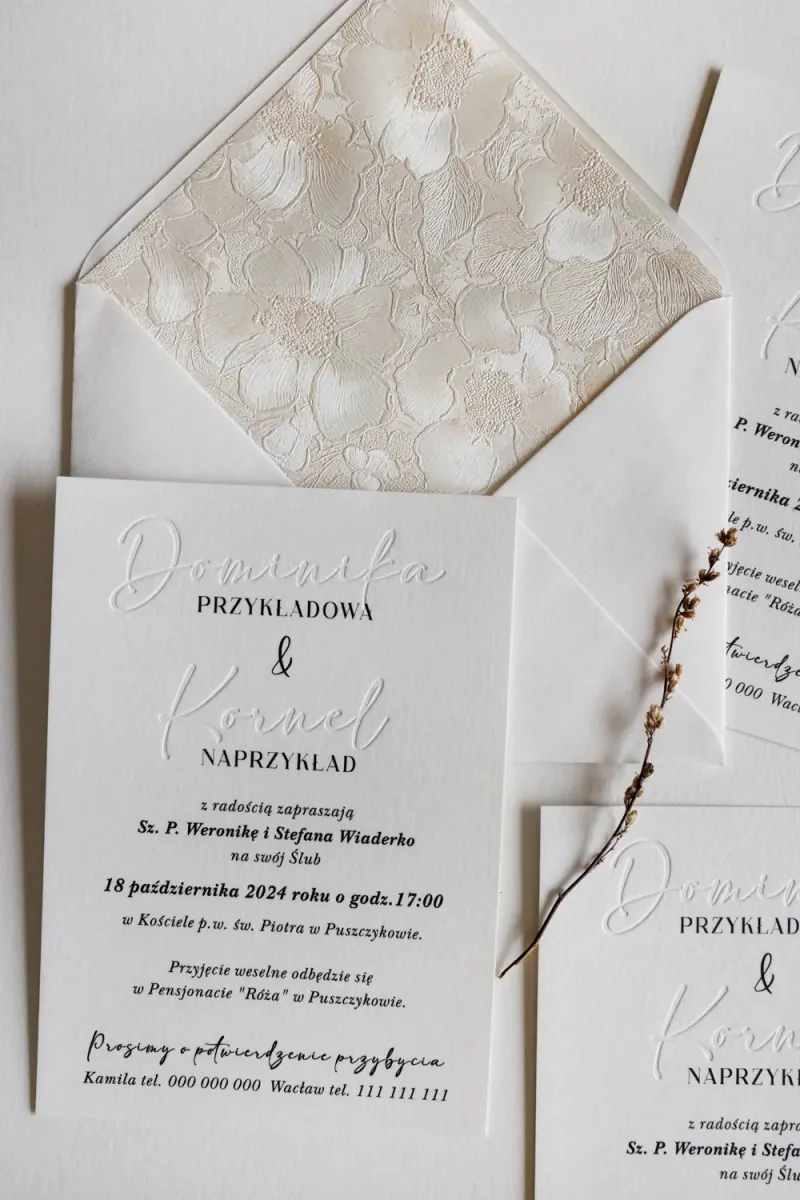
Elegant Wedding Invitations with Embossing | Wedding Invitations | Karmen nr 4
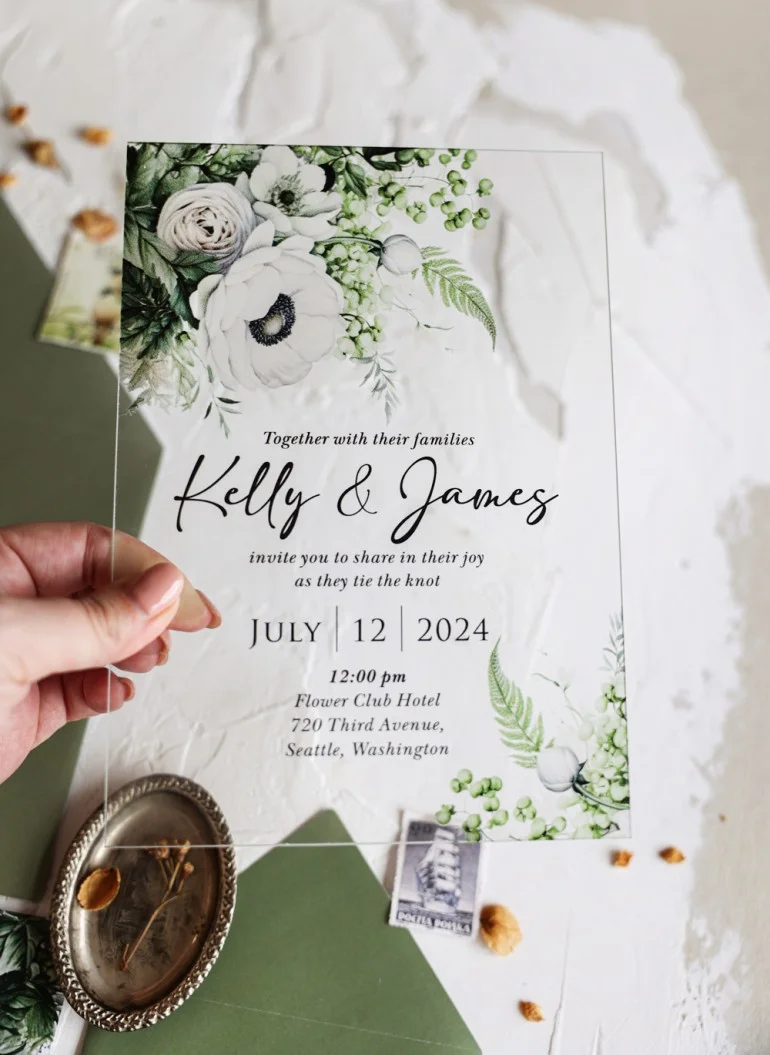
Subtle Glass Wedding Invitations with Floral Motif in Shades of White and Green | Korani nr 15
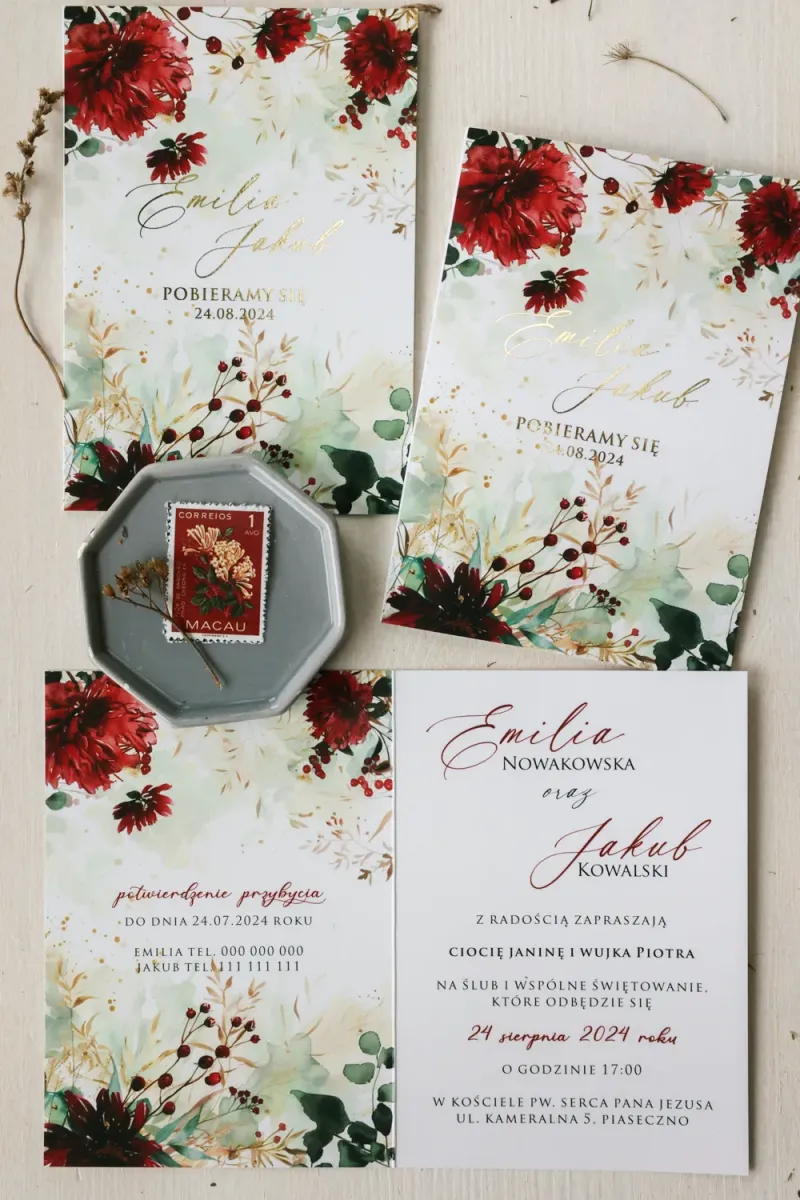
Wedding Invitation with Gold Accent and Red Flowers | Glamour and Boho Wedding Invitations | Ruskus nr 1
Mindfulness to Avoid Hurting Anyone's Pride
When involving both sides of the family, remember diplomacy. It's about ensuring that neither side – neither your mother nor your future mother-in-law – feels less important. If, for example, you intend to delegate many tasks to the groom's mother, warn your own mother and explain that there will be an important role for her too. Sometimes the Bride's mother may feel a pang of jealousy that the "new mother" is interfering in her daughter's affairs. It's worth reassuring her beforehand: "Mom, you're the most important to me and I need your help with so many things… e.g., I'm counting on you for the dress selection and the overall wedding vision because you know my taste. And Janek's mom will handle things she cares about, like flowers. Each of you has your contribution." Such a conversation can prevent quiet resentments. Similarly for the future father-in-law – if you see he is rather withdrawn but doesn't want to be less than his wife or your parents, find a task for him suited to his interests. Maybe he could prepare a list of songs he'd like to hear at the wedding (fathers like choosing dance classics) or handle ordering the wedding vodka because he knows his spirits? This way, each parent feels important and appreciated. The key is direct communication: thank, praise, and emphasize how valuable their help is. A simple "We couldn't have done it without you" said from the heart means a lot to parents and motivates them to continue cooperating on your terms.
How to Maintain Decision-Making Without Hurting In-Laws' Feelings
Assertiveness in Making Wedding Decisions
Despite the best cooperation, the moment will eventually come when you have to say "no" to one of the parents' suggestions. Assertiveness is an art – especially in a family where feelings are easily hurt. But it is possible to say "we don't agree" in a way that doesn't start a civil war. Above all, be firm about matters that are key to you. If you know you absolutely don't want something at your wedding (e.g., cheesy music on the dance floor or inviting distant cousins you have no contact with), make it clear as soon as the topic arises. The worst thing you can do is stay silent out of politeness and then quietly do your own thing – this breeds conflict and resentment. Instead, speak openly about your needs and visions. Imagine the situation: you're at a family dinner with your fiancé, and the mother-in-law and aunts are talking about "how great it would be if you hired a traditional band because a DJ just isn't appropriate." You feel a lump in your throat because you dreamed of a modern DJ, but you stay silent out of respect. That's not the way! Find the assertiveness here and now – calmly but clearly say: "Actually, we've already decided on a DJ. We really like modern music and we're sticking with that. We understand that for you a band is tradition, but we hope you'll respect our decision." Such a statement can stop further bidding of ideas. You are polite but unambiguous. Importantly, speak in the plural – "we decided, we like" – showing that as a Couple, you are a unit. If the mother-in-law still tries to persuade you, you can add with a smile: "Mom, it's our wedding, right? Allow us to do it our way. We promise it will be a great party – including songs you like!". In assertiveness, consistency is important – once you calmly but surely express your opinion, it will be harder for parents to undermine it. Remember also that you have the right to refuse, even if parents are older and you usually listen to them. Assertiveness is not rebellion or lack of respect – it's taking care of your own needs while respecting the needs of others. You can be assertive and polite at the same time.
Elegant wedding cake box with personalization | Szafirowe nr 3
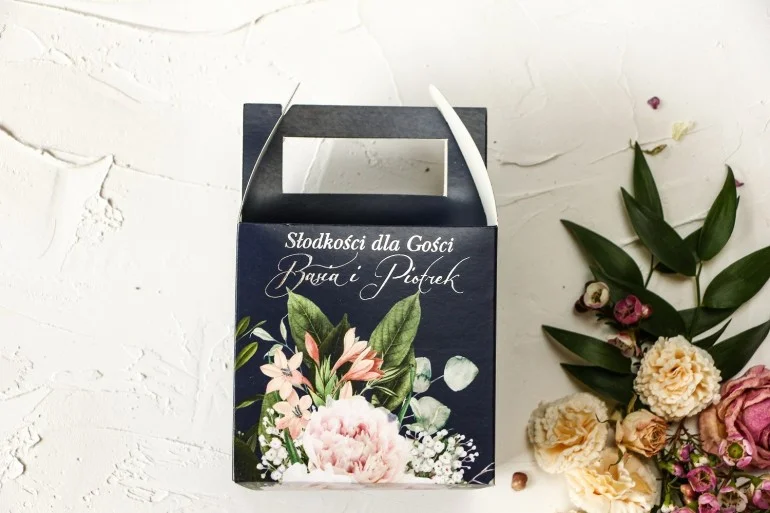
Square wedding cake box in glamour style | Pastelowe nr 3
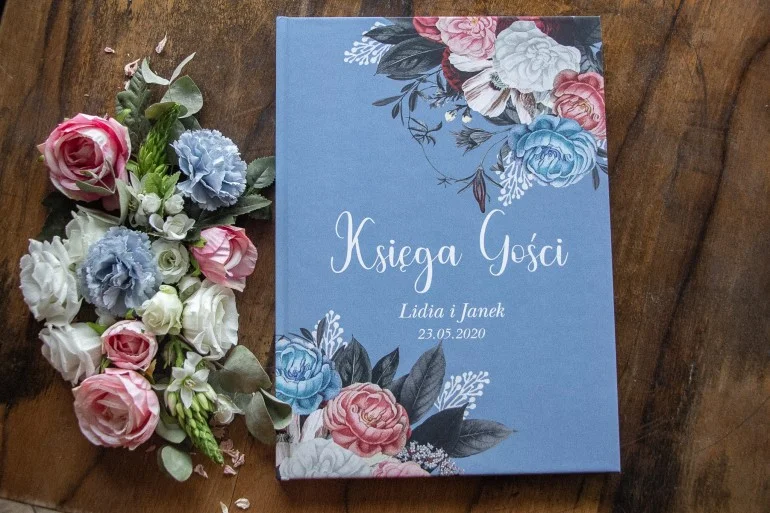
Watercolor Guest Book in shades of dusty blue and pink | Eteryczne nr 4
Politely Refusing and Arguing Your Point
When you say "no" to parents, the form of delivery matters immensely. Instead of just cutting it off with "No, because no," always explain your reasons. Parents will accept your decision much more easily if they understand where it comes from (even if they don't agree). In practice: use the "I feel/think that... therefore we decided..." message. Example: "Mom, we know you'd like to invite a few of your friends to our wedding. However, we've set a limit of 80 people and it's mainly close family and friends. We feel that too many guests would take away from the intimate character of our celebration, which is very important to us. Therefore, we can't expand the list, I hope you understand." Such a response is factual and refers to feelings ("we care about an intimate atmosphere"). Mom may initially feel disappointed, but the explanation helps her not take it personally. It's also important to thank them for ideas, even rejected ones. You can say: "Thank you for suggesting that – we've thought about it and we'll go a different way…". Then parents see you aren't ignoring their opinion. A good way to politely refuse is also to suggest an alternative. Suppose the in-laws are pushing for a big post-wedding brunch (second day), and you'd rather avoid it. Instead of just saying "we're not doing it and that's it," you could suggest: "Instead of a brunch, we'd rather organize an elegant dinner for our closest ones the day after the wedding. It will be calmer, and we'll still spend time together. What do you think?". This way, you give something in return – parents feel their desire for shared celebration hasn't been completely rejected, just modified. The key is the tone: polite, calm, with respect. Avoid sarcasm or criticism like: "Your ideas are old-fashioned, we don't want that" – this is guaranteed to hurt. Instead: "We have a different idea that suits us better." When in-laws hear you speak firmly but kindly, there's a good chance they will accept your decisions despite initial resistance. They might even appreciate your maturity.
Setting Boundaries with Respect
Every relationship needs boundaries – including the relationship between future in-laws and the engaged couple. Boundaries are certain areas where outsiders (even parents) should not enter without an invitation. In the context of wedding planning, boundaries might concern, for example, your relationship, finances, or very personal choices. If you feel parents are crossing a boundary, react immediately before resentment and anger grow. It's best to do this one-on-one so as not to embarrass anyone publicly. Suppose your future mother-in-law has a habit of commenting on your figure and suggesting a diet before the wedding ("Maybe you'll lose another 2 kilos for the wedding, huh? That dress will fit better"). For you, this is very hurtful – a boundary has been crossed because you decide on your appearance. To take care of yourself, it's worth checking out the pre-wedding health and beauty plan, but the decision is yours. Instead of avoiding her for a week with an offended face, try to talk calmly: "Mom, I'd like to tell you something. It really hurts me when you comment on my weight. I don't feel good hearing such remarks. Please, don't do that – I know best how I want to look at the wedding. I'm counting on your understanding." Such a statement may require courage, but it sets a clear boundary – and does so with respect ("please, don't do that"). Another example of a boundary might be the couple making decisions independently without surprises from parents. If, for example, you find out that your future father-in-law paid a deposit for a band behind your back because he thinks there must be a band – that is a serious boundary violation. How to react? Ideally, the son (future groom) should have a serious, honest male dialogue: "Dad, I appreciate that you want to help, but I felt bad that you made a decision for us. It's our wedding and we want to discuss such decisions together. Please, don't arrange anything without our knowledge. Let's talk – I'll explain why we prefer a DJ." Such a message, while firm, still maintains respect ("please, let's talk"). Then follows an honest conversation – one-on-one, calmly, without an argument. It may turn out that the father-in-law thought he was doing good because he wanted to take a problem off your hands. Well, the road to hell is paved with good intentions – but sometimes one conversation is enough for a parent to understand they went a step too far. Setting boundaries often involves a temporary wounding of a parent's pride ("how can my child tell me I'm not allowed to do something?"). However, in the long run, most in-laws appreciate such honest positioning – they know where they stand and can adapt. It's important that this always takes place while maintaining respect for their position as a parent. Boundaries are not walls of enemies, but a fence between gardens – you can talk over the fence, but don't enter without asking.
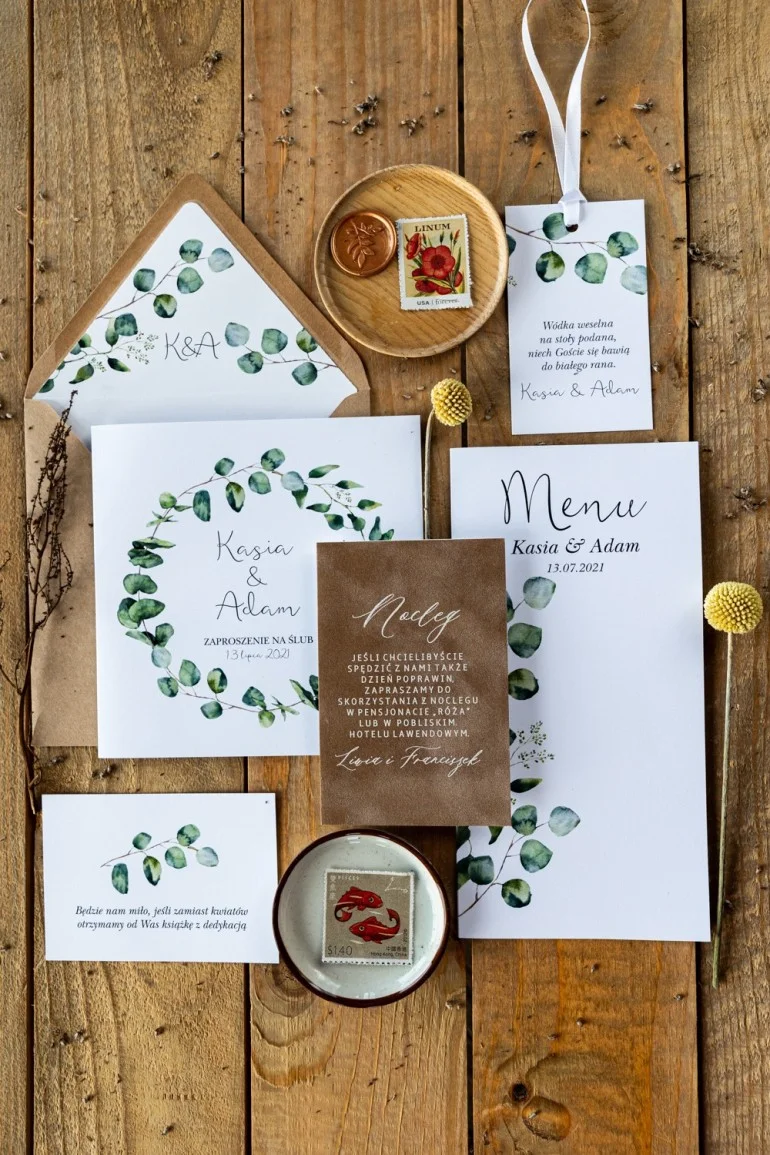
Eco-friendly Invitation with Greenery Styling | Wedding Invitations in eco envelope | Kalia nr 2
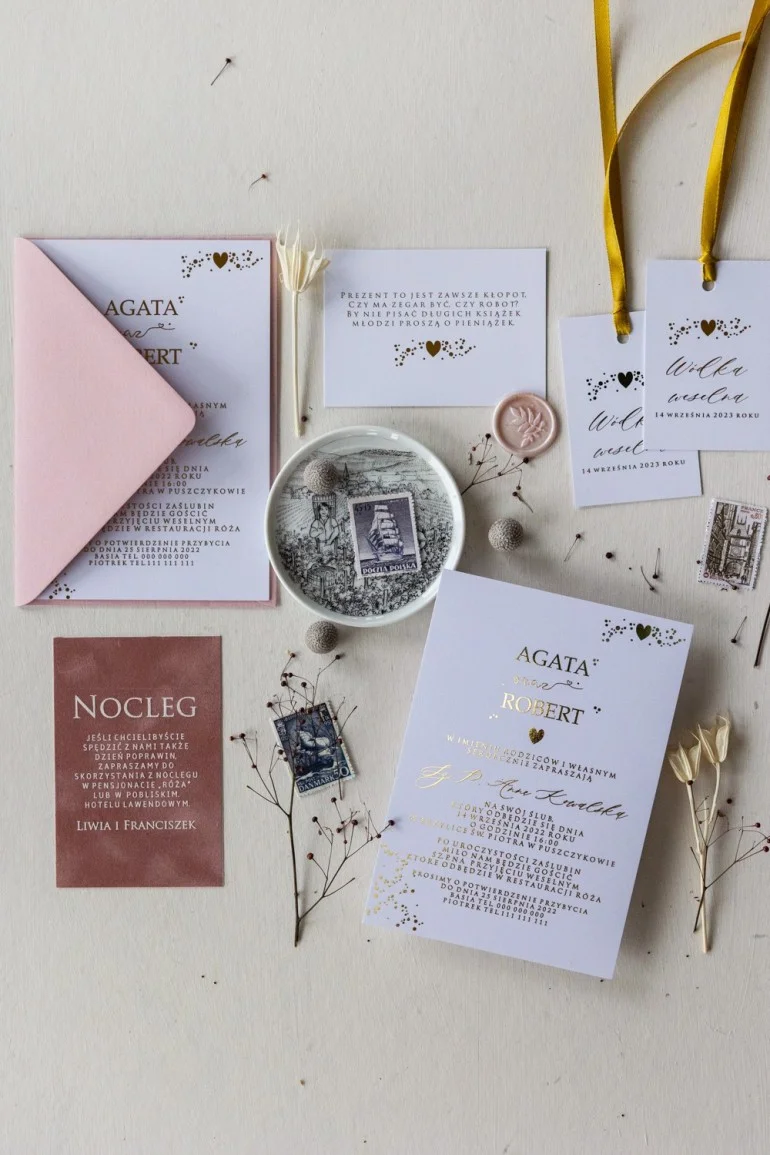
Subtle Wedding Invitations, Minimalist Design with Gold Elements | Simple nr 3
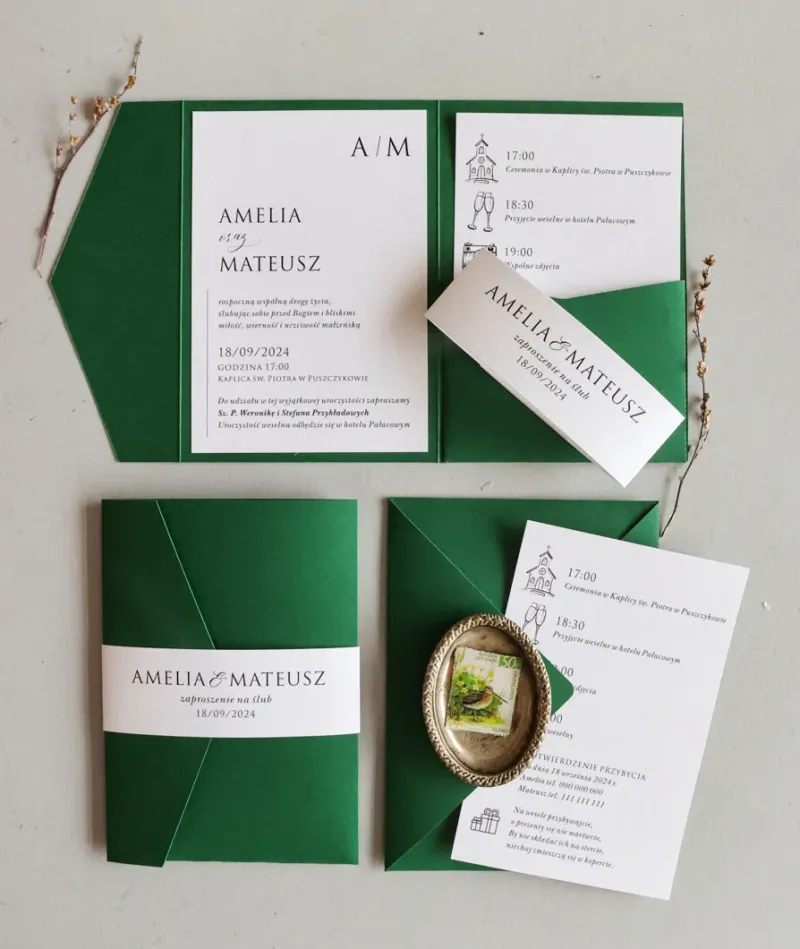
Elegant Wedding Invitations in Shades of Bottle Green | Minimalist Design and Modernity | Kraft nr 10
A United Front of the Engaged Couple
An extremely important aspect of maintaining decision-making and peace is unity between you, the engaged couple. Parents (even subconsciously) may try to "pull to their side" their own child – e.g., a mother influences her son: "Talk to her so she has a dress with a veil, our family won't accept it otherwise." If a partner starts giving in behind your back on such matters, tension will arise between you, and the in-laws will take the helm. Therefore, from the beginning, establish: we make decisions together and always support each other in front of the family. When one of you feels pressure from their parents, they should be able to say: "I need to discuss this with my fiancé/fiancée – we'll give you an answer later." Avoid situations where, for example, the future groom agrees with his mother to "keep the peace" and later informs the bride "you know what, mom invited extra guests anyway, I agreed" – this is a straight road to conflict in the relationship. A united front also means mutual defense when necessary. If your parents criticize your beloved regarding organization ("because she doesn't know anything, everything is last minute"), your role is to stand by your partner and cut off such comments. And vice versa – he should react to his parents. When in-laws see the couple standing together like a wall, they will think twice before trying to outvote one of you. Stick to the rule: "we never criticize the partner in front of our parents, nor do we allow them to do so." If you have a different opinion from your fiancé on a wedding decision – first reach an agreement between yourselves in private, and only then present the position to the parents. This avoids the dangerous situation where, for example, the mother-in-law nags: "Persuade her to get a different venue, this one is too expensive" and finds fertile ground because the son himself isn't convinced. It's better to explain to each other why the more expensive venue is important to you and only then argue together to the parents. Remember – your unity is your strength. When in-laws see a happy, harmonious couple who can support each other, it's easier for them to accept giving you the reins. In the end, their child has found a partner with whom they form a team – and that's what every parent wants to see in the long run.
Effective Communication and Conflict Resolution
Honest Conversation as the Foundation
Conversation is good for everything – it's not a cliché, but a truth we sometimes forget when emotions run high. When you feel tensions rising with your future in-laws, the best remedy is an honest meeting and a calm exchange of views. It's important to conduct such a conversation on neutral ground and in favorable circumstances. It's better to meet for coffee at the parents' or a favorite café than to discuss between doors or in front of the whole family during an aunt's name day. Choose a moment when everyone has time and is in a relatively good mood (just after work, when everyone is tired, is a bad idea). Start the conversation with positives: thank them for their help so far, praise something that went well ("Thanks to your support with the dress, everything went smoothly, Mom, thank you again for being with me at the seamstress"). Then move on to the contentious issues, but without mutual blaming. Speak about facts and your feelings: "We've noticed that some misunderstandings have appeared between us lately. We'd like to talk about it because we care about good relations. It hurt us a bit when [situation] happened, because we felt [feeling]." For example: "We were a bit worried when we found out you set the wedding time with the priest without us – we felt left out. We understand you wanted to help, but next time we want to be part of such decisions." Such a tone gently signals the problem without attacking anyone personally. Also, give future in-laws a chance to speak – ask how they see it, if anything worries them, if they have their own grievances. Listen carefully, don't interrupt. Maybe the Bride's mother will say: "I felt unneeded when you refused to let me come to the cake tasting" – then you have the opportunity to explain: "We're very sorry, we didn't want to exclude you. We thought you didn't have time – we'll definitely invite you next time." See – one conversation, and so much is cleared up. Most conflicts result from a lack of communication or misunderstandings that are easily explained by a calm talk. So don't be afraid to initiate dialogue. It requires maturity, but it will benefit everyone. What's more, such family councils bring people closer – they show you care about the relationship and are ready to work on it, rather than harboring grudges.
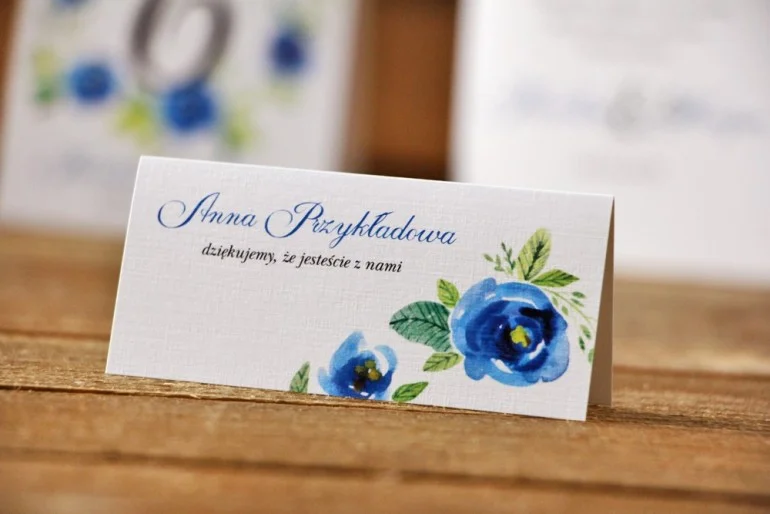
Place cards on linen-textured paper with blue roses | Akwarele nr 10
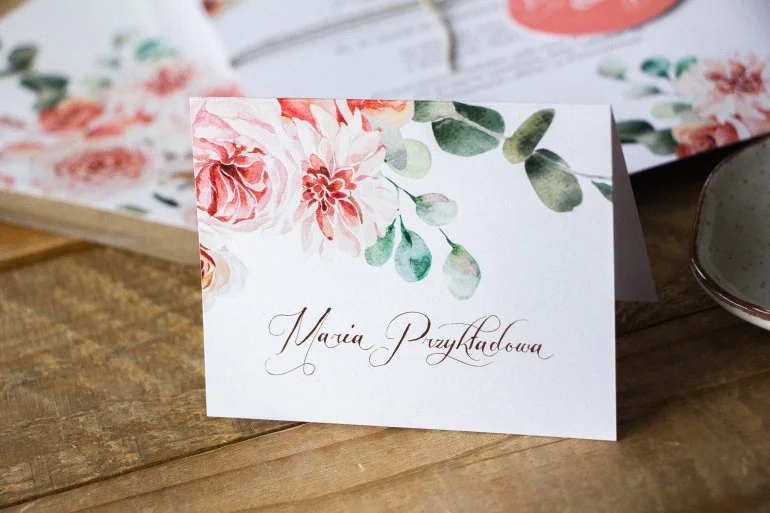
Place cards with pink bouquet composition | Indygo nr 7

Wedding Place Cards on pearlescent cream paper with green decorations | Opal nr 11
Active Listening and Showing Respect in Discussion
During conversations – the easy and the difficult ones – remember the basic rules of communication culture. Simple things have great power. Maintain eye contact, nod when the other party speaks – these are signals that you are listening. Restrain the urge for an immediate retort, especially if you hear criticism. Allow the in-laws to finish speaking, and only then respond. Often people just want to feel heard. When the mother-in-law expresses all her concerns or claims, she may feel relief just from the fact that you listened without interrupting. Try to understand, not just answer. This means: instead of mentally preparing a counterargument, try to empathize with what Mom or Dad is saying. You can even paraphrase: "Do I understand correctly that you're afraid our idea for an outdoor wedding might fail because the weather might let us down?" – such a response shows you are taking their words seriously. Showing respect also manifests through language: saying "Mr./Mrs." or by an agreed name (if you're on first-name terms), a tone without sarcasm, and not raising your voice. Even if one side starts to get heated, try to remain calm – this often tones down the speaker. Also avoid generalizations and harsh words: "because you ALWAYS do something," "because you NEVER listen" – such phrases escalate conflict. It's better to focus on a specific event and your own emotions: "I was sad when X happened because…". Then the in-laws don't feel attacked "ad personam," but see what effect their action caused. Respect is also admitting when the other side has a valid point. If, for example, the father-in-law says: "I'm worried you want to take a loan for the wedding, it's unnecessary debt" – instead of immediately getting offended, you can say: "We understand you're worried about our financial future. It's true that a wedding is a major expense. We appreciate your concern. We'll rethink our budget once more." Even if you ultimately do it your way, such words will diffuse tension. Active listening and showing respect make parents feel important and see that you take them seriously – and that often cuts off their potential grievances before they even appear.
Seeking Compromise and a "Win-Win" Solution
It's not always possible to fully reconcile the interests of all parties – that's clear. But compromise is the friend of every family negotiation. In the context of a wedding, it's worth looking for solutions that partially satisfy both you and the parents. The strategy is simple: determine what is absolutely most important to you and what can be subject to negotiation. Simultaneously, try to understand what is key for your parents. Then try to steer the agreements so that each side gains something. A classic example: you want a DJ, parents dream of a band. Compromise option: a DJ plays during the reception (your desire), but for example, for the bread and salt welcome, the first dance, or the apron dance, you hire a small live band that plays traditional pieces (a nod to the parents). Or you ask the DJ to weave a block of the parents' and their generation's favorite songs into the setlist – announcing it as a dedication to them. In this way, the parents' joy and your vision merge. Another example: you want minimalist decorations, Mom dreams of gold accents. Solution: you go with minimalism for the overall decor, but for example, the napkins or candle holders are gold, as Mom wanted. She sees her touch, you don't have the whole hall overwhelmed by gold. Try to analyze every contentious issue "humanly," as you would advise friends. Ask yourselves: will a concession in this matter hurt us much? Can we give something to make the parents happy while not giving up what's essential to us? Often it turns out you can. If, for example, Dad really wants to invite his friend whom you barely know – maybe it's worth adding that one or two extra guests to please him? If it doesn't entail huge costs and doesn't ruin your concept of an intimate gathering (two guests won't turn an intimate wedding into a crowded party), then why not. For him, it's fulfilling an obligation to a friend; for you, it's a minor change. This is how a family atmosphere is built: "we win and you win." Of course, compromise isn't always possible – there are binary issues (e.g., wedding location: either in the hometown or elsewhere). If you can't split the difference, then the Couple should have the deciding vote – after all, it's your day. Nevertheless, show parents that you looked for solutions, that you wanted to make them happy. Sometimes that alone is important to them. They might say: "Fine, do as you want – but thank you for taking our suggestions into account and trying to come up with something." Remember also to appreciate every compromise from the parents. If the mother-in-law agreed to something, even if it's clear she doesn't fully like it, thank her: "We know you'd prefer it differently, so we appreciate all the more that you accept our decision." Such words ensure no one feels like a loser – because you're all playing for the same team.
When Emotions Rise – Maintaining Calm and Distance
During preparations, there may be moments when, despite best intentions, the atmosphere gets hot. Imagine: you're discussing the same issue for the third time, arguments are repeating, and no one is yielding. Voices are rising, someone throws out: "Because you always have to have it your way!", to which comes the retort: "And you only think of yourself, not the family!". Do you know that moment when a dispute slips off the substantive track? That's a signal to stop. There's no point in continuing an argument in a state of agitation because words can be said that are later regretted. Instead, suggest a break: "Stop, let's pause. I see we're all upset. Let's come back to the topic tomorrow/in a few hours, okay? Let's cool down now." Such a step back is a sign of maturity, not defeat. Everyone needs to breathe sometimes and look at the situation from a distance. After a break (whether an hour or the next day), emotions subside and it's often possible to return to the conversation in a better tone – or even decide it's not worth fighting over a trifle. In a family, nothing is so important that it should override mutual kindness. If you feel a conflict with in-laws is becoming very serious and you can't resolve it yourselves, consider the support of a third party. It could be someone in the family who has authority and can mediate – e.g., the Bride's father softens a dispute between the mother and daughter-in-law because both listen to him. Or a friendly talk with a priest or wedding consultant, if you have access to one. Sometimes one objective look from the outside helps the parties come to their senses. However, that's a last resort – usually, you can come to terms with parents yourselves using the above communication methods, with a bit of patience and goodwill. It's worth reminding yourself in tense moments: "We all want the same thing – a successful wedding and the happiness of our loved ones." This awareness helps you find balance and not let short-term conflicts poison the joy of preparations.
Building Understanding and Strengthening Bonds with Future In-Laws
Small Gestures That Strengthen the Relationship
Often it's the little things that determine how a relationship goes. During the wedding preparation period, full of tasks and stress, it's easy to forget about kindness and simple human gestures. Meanwhile, small gestures have huge meaning in building a warm bond with future in-laws. Try to show your partner's parents that they are important to you not just as "task performers" in organizing the wedding, but simply as people who will soon become family. How to do it? Here are a few ideas: invite your future in-laws for a joint dinner or BBQ for no reason – let it not be a wedding meeting, but a pleasant time spent together. Show photos from your preparations – e.g., from a suit fitting or the wedding venue – even if they were there, share the enthusiasm: "Look how beautiful the hall looks with this lighting, we can't wait!". Such sharing of joy engages them emotionally. Another gesture could be asking your future mother-in-law to go shopping for wedding accessories together – let her help you choose jewelry for the dress or a tie for her son. It's a small thing, and it will give her a sense that she can participate in important moments. If you have an important family holiday during preparations (e.g., a parent's birthday), make sure to remember it despite the wedding commotion – give wishes, buy a symbolic gift from both of you. Another nice gesture: ask for advice on a completely unrelated matter. For example, the father-in-law knows about cars – consult him on which car is best to drive to the wedding or if it's worth renting a limousine. You might take the advice or not, but he'll feel you value his knowledge. Does the mother-in-law love to bake? Ask for a recipe for a special family cake for the wedding table – even if the bakery ends up baking it, Mom will feel pride that the recipe went out into the world. Small gestures like: shared coffee, remembering the mother-in-law's favorite flowers (e.g., come to a meeting with one rose for her), a compliment like "Your son learned this so beautifully from you – he's so well-organized" – all this creates an atmosphere of mutual kindness. People who feel liked and appreciated automatically become more cordial and helpful. So if you want to gain a friend in your mother-in-law and a second dad in your father-in-law – start with small signs of sympathy. Over time, they will pay off a hundredfold.
Getting to Know Each Other Outside the Wedding Topic
It's easy to fall into the trap where every conversation with future in-laws revolves around the wedding: arrangements, things to do, progress reports. However, try to step outside this pattern and get to know each other as regular people, not just "parents and children organizing an event." Suggest something together that has absolutely nothing to do with the wedding – e.g., a family trip out of town, a walk, going to a concert or a game (if you have shared interests). Maybe your future father-in-law likes fishing? If the groom also has the patience for it, let them go to the lake together – time spent one-on-one doing something relaxing brings people very close. Or if the future mother-in-law is interested in art and the future bride likes it too – a visit for the two of them to an exhibition or floral workshops can be a wonderful break from wedding talk and allow you to establish a more cordial contact. Getting to know each other is also about conversations on topics other than the guest list. Ask in-laws about their youth, passions, and the history of their marriage. You might hear funny anecdotes about how they met and what the world was like when they were your age. People like to talk about themselves, especially if they see sincere interest. Listening to in-laws' stories will not only deepen your bond with them but also help you understand your partner better – after all, "the apple doesn't fall far from the tree." You might learn that your future husband likes cycling because his dad took him on trips every weekend – that builds sympathy, doesn't it? Another idea is to include your parents and in-laws in one group – so they also get to know each other. Often the integration of both families helps diffuse potential tensions. You can organize an introductory dinner where you not only discuss wedding matters but also just spend time so that parents from both sides like each other. When your parents and in-laws find a common language, it will also be easier for you – an atmosphere of one big family will arise instead of "us and them." This pays off not only during the wedding (where parents cooperate, e.g., in welcoming guests) but also for the future. Generally, the more positive experiences you have together, the fewer potential conflicts. When at the next discussion about decorations you remember how fun it was at the BBQ at the in-laws' last week, it's harder to have a sharp argument – there's a thread of sympathy between you. So invest time in being together not just for discussing matters, but for the pleasure of being together. It's worth it!
Showing Gratitude and Appreciation
Nothing melts ice and builds good relationships like sincere gratitude. Your future in-laws are surely doing many things during preparations – some more, some less in line with your expectations – but they are certainly putting their heart into it. Don't forget to regularly thank and praise them for their contribution. And not just at the end, but on an ongoing basis. When the groom's mother goes with you to look at dresses, say afterward: "Thank you for being with me. Your opinion really helped me, I'm glad we could experience this together." When the Bride's father gets a discount from a videographer friend, appreciate it: "Great, Dad, we saved a lot thanks to you – you played that perfectly, you're irreplaceable." Such praise gives them authentic pleasure – who among us doesn't like to feel needed and helpful? You can also express appreciation publicly: e.g., telling friends in front of parents "We chose the dress together with my future mother-in-law – she has great taste, doesn't she?" – you'll see the pride in her eyes. Or "Dad found this wedding venue – he did a stellar job, we liked it immediately" – a small thing, but it builds positive emotions. In addition to words, think about symbolic gestures of gratitude. Many Couples give parents gifts or special thanks on the wedding day – it's a beautiful tradition worth cultivating. You can prepare small gifts for your parents and in-laws (e.g., an album with shared photos, a decorative card with personal thanks, a bouquet of flowers given during the wedding along with a toast in their honor). In these thanks, it's worth including the wedding preparation period: "Thank you, dear parents, for the huge help in organizing our wedding, for every phone call made on our behalf, for every piece of advice and kind word. Thanks to you, this day is even more beautiful." I guarantee more than one eye will get misty – including the in-laws', because they will hear that their efforts were noticed. Such public appreciation in front of the whole family and friends also has an additional advantage: it builds your image as a harmonious family and silences potential critics. If there were any glitches, they will be forgotten in the face of emotion. After the wedding, also don't forget to maintain the good atmosphere – give parents the developed photos or film, mention occasionally how wonderfully everything turned out together. Building a bond with in-laws doesn't end at the wedding – actually, it's just the beginning. But if during the engagement period you work out a relationship with them based on understanding, respect, and gratitude, the future years will be much richer in family warmth than in conflicts. And surely everyone dreams of having a second mom and a second dad they can count on – and of being treated like a son/daughter themselves, not a stranger son-in-law/daughter-in-law.
Mutual Understanding of Needs and Concerns
Finally, remember that the relationship with future in-laws is a process. You won't reach perfect harmony immediately – and that's normal. However, it's important that both sides feel there is a desire for understanding on the other side. Try to empathize with their situation: they are entrusting their child to your care, they want the best for them, sometimes they fear a new role (especially mothers of sons often have a fear that the daughter-in-law will push their son away from them). Such fears can cause various strange behaviors – control, insistent advice-giving, sometimes even competition for the child's attention. If you notice such signals, don't get angry immediately, just talk honestly. Reassure them that their son/daughter still loves them and will be part of their life, and you want to be an extension of that, not an obstacle. A new family doesn't exclude the old one – on the contrary, it expands it. When in-laws understand they aren't losing a child but gaining another, some of the tension will disappear. You, in turn, be ready to communicate your own needs clearly but gently. If, for example, you sometimes need space just for yourselves, you can say: "We love visiting you, but this coming weekend we want to be alone and rest. We'll see you in a week, okay?". This is better than avoiding a phone call from parents. Mutual understanding requires patience – perhaps the groom's mother needs a little time to fully trust you and really like you, or maybe your dad needs to get used to the fact that he's not the only one who's right when setting wedding details. Give yourselves and them that time. Build rituals: maybe every other Friday you discuss progress together and then watch a comedy to relax. Maybe you'll agree to meet everyone once a month for a joint dinner – and not talk about the wedding, but about life. A relationship with in-laws, like any other, requires an investment of time, attention, and heart. But before the wedding, you have the perfect opportunity to invest – because there's a specific project to realize that naturally brings you closer. Use this time as best as you can to set strong foundations for your further, "post-wedding" relationship with your new family.
Summary: Shared Goal, Shared Joy
Relationships with future in-laws during the wedding organization period can be a challenge, but also a unique opportunity. An opportunity to create a truly harmonious team with your partner's parents, all striving for one goal – a beautiful, successful wedding and the happiness of the young couple. The key to success is communication, respect, and a willingness to cooperate. Remember that your parents and in-laws have a wealth of emotions related to your wedding – just like you. If you approach them with heart, understanding, and openness, you will gain allies, not opponents. In practice, this means involving them where they can help, clearly setting boundaries where necessary, politely but firmly communicating your decisions, and diffusing conflicts with calm conversation and compromise. Add to that a handful of cordial gestures and appreciation for their efforts – and you'll see how tension gradually turns into cooperation, and cooperation into true family warmth. Even if difficult moments arise along the way (and that's natural), approach them like passing storms – they will pass in time, and the sun will come out when you all celebrate your big day together. Finally, it's worth emphasizing that you are not alone in this. Many couples struggle with similar dilemmas, and many of them have been able to work out great relationships with in-laws – which often bears fruit for a lifetime. Use the advice of the more experienced, get inspired (e.g., on the Amelia Wedding blog you will find many tips from wedding industry experts). And above all, listen to each other and your loved ones. Shared dialogue, mutual respect, and a bit of empathy can work wonders. Your wedding is not only your holiday but also an important day for your families – allow them to experience it together with you, in an atmosphere of joy and love. Thanks to this, you will not only organize a wonderful wedding but also gain something priceless: stronger family bonds that will remain long after the wedding decorations are taken down and the photo album hits the shelf. We wish you that organizing your wedding becomes a beautiful family adventure, and that relationships with future in-laws are a source of support and joy – now and in the future. Good luck!
Recommended articles:
- Top 10 mistakes made by Couples during wedding organization
- Why is it worth having a wedding day schedule?
- How to ensure consistency between invitation style and wedding decor?
- Dream Honeymoon: How to plan a unique honeymoon or mini-moon?
- Wedding speeches and toasts: How to prepare the perfect speech and thanks at the wedding?
- Star Guests: How to take care of those invited on the wedding day so they feel special and comfortable?
- When to start planning a wedding?
Szymon Jędrzejczak
Wedding industry expert and stationery designer at Amelia-Wedding.pl. For years, helping couples create unforgettable moments by combining tradition with modern design.