How to Write Names on Wedding Invitations?
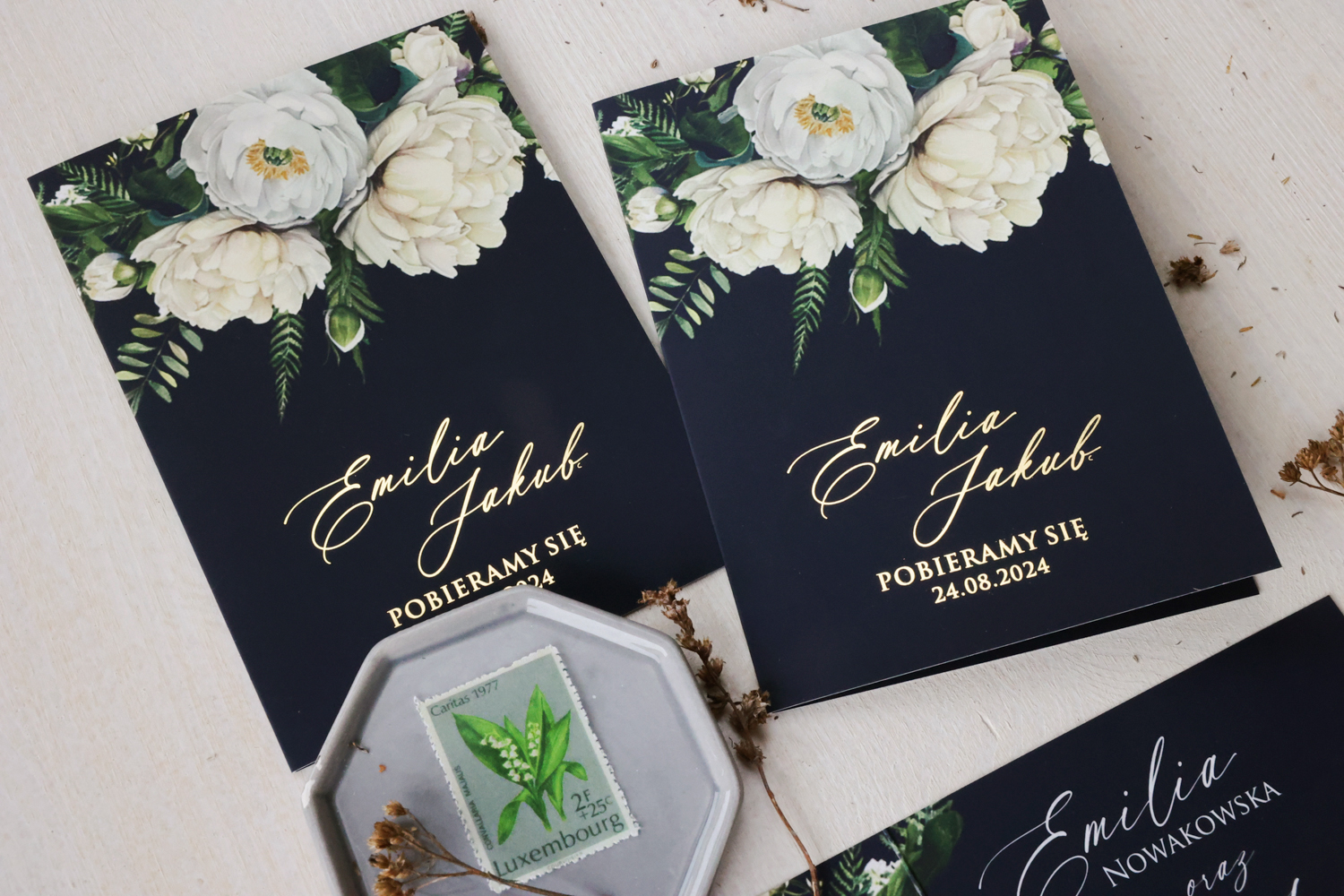
When inviting guests to your wedding, you want the wedding invitation itself to be an expression of your respect and attention to detail. One of the key elements is correctly writing the names of all invited guests. While it may seem simple, etiquette and grammar—especially regarding declension and titles—can sometimes pose a challenge. Below, we present a complete guide on how to write names on wedding invitations in various situations (formal and informal) according to established rules and good customs. You will learn how to avoid common mistakes, discover best practices, and see specific examples of correct forms.
Table of Contents
1. The importance of correct spelling on invitations
Names as a guest's calling card
A name on a wedding invitation is more than just information – it is a personal calling card for the guest. Correctly recording this data is an expression of respect for the invited person and demonstrates the professionalism of the couple. Every guest wants to see their name written without errors. A minor mistake – even a typo or an incorrect suffix – can make the invited person feel ignored or offended. On the other hand, carefully written personal details build a positive impression and herald a celebration refined in every detail. Remember that an invitation often becomes a keepsake; so it is worth ensuring it is elegant and correct in every respect.

Impresja No. 10 Wedding Invitation – Eucalyptus and Gold Foil

Minimalist Wedding Invitation Pattern No. 3 – Lavender and Gold

Lauren No. 4 Wedding Invitation – Boho Style with Camel Envelope
Invitation aesthetics and linguistic correctness
Attention to correct spelling is linked not only to politeness but also to the aesthetics of the invitations. A poorly declined name or incorrect spelling can disrupt even the most beautiful stationery design. Imagine a stylish, graphically refined invitation where the guest's name stands out due to an error – such a detail can ruin the entire effect. Correct language is especially important in formal wedding invitations, where we strive for elegance and class. Care in spelling shows that the couple takes both the language and their guests seriously. If you feel unsure about the declension or spelling of names, it is worth seeking help (more on this in the practical tips section). This way, your wedding invitations will be not only visually beautiful but also linguistically flawless – something all recipients will surely appreciate. If you are looking for stationery that meets the highest aesthetic and quality requirements, visit the wedding invitations page, where you will find many elegant designs for personalization.
Why names on invitations should be declined?
Many people ask: should names on wedding invitations be declined by cases? The answer is: yes, absolutely!. This follows from the rules of the Polish language – if a formula like “we invite...” appears in a sentence, the question whom are we inviting? should follow, and the name must be appropriately declined. In other words, an undeclined form of a name is incorrect, sounding artificial and unnatural. For example, the sentence: “We cordially invite Anna Kowalski” is linguistically wrong – it should correctly be “invite Anna Kowalska”. Despite fears of making a mistake, one should not avoid declension. Some couples try to cleverly bypass this issue by arranging the invitation text so that the name remains in the nominative case. However, such a solution often looks awkward and sometimes still doesn't protect against error. Knowing basic grammatical rules, you can decline names without fear – making the invitation linguistically standard and fully professional. In the following sections, we will explain in detail how to decline female and male names, in the plural, and in unusual situations, as well as which honorifics to use so that everything sounds elegant.

Aurum No. 1 Wedding Place Cards – Purple Freesia and Peony Floral Table Cards

Glamour Wedding Place Cards No. 1 – Satin Name Cards with White Print

Avril No. 10 Wedding Place Cards – Gilded Glamour Table Name Cards
2. Declension of names – basic rules
Male names – always declined
The rules for declining male names on invitations are relatively simple: male names are always subject to declension in the invitation text. Regardless of whether the man's name ends in a consonant (e.g., Nowak, Kowalczyk, Wróbel) or a vowel (e.g., Kozioł, Iksiński), we must use the correct case form. In practice, this means:
- If the nominative (basic form) is Jan Kowalczyk, then in the invitation (e.g., in the sentence "We invite...") we write Jana Kowalczyka, not Jana Kowalczyk.
- Similarly, Adam Mazur changes to Adama Mazura, Paweł Dudek to Pawła Dudka, etc.
- Male names ending in -ski, -cki, -dzki, -ży, -czy are also declined according to the rule – e.g., Adama Wiśniewskiego (from Wiśniewski).
There are no exceptions here – every Polish male name should be declined by cases in the invitation text. This also applies to names of foreign origin worn by men – more on that in a moment. If we fear that the declined form sounds strange, it's worth remembering that the lack of declension sounds much worse. Polish speech is clear here and requires us to adapt male names to the context of the sentence.

Soy Candle Rubin No. 1 – Foiled with Flowers and Wedding Favours

Golden Fortune Cookies with Personalized Label | Affordable Wedding Favours | Cejla No. 3

Simple No. 3 Soy Candle – Gold Foiling & Elegant Wedding Favours
Female names – when to decline them?
In the case of ladies, the rules are slightly different. Female names are declined only in selected cases. The general rule is: if a woman's name ends in “-a”, it is subject to declension; if it ends in another letter (a consonant or a vowel other than -a), it remains undeclined. Examples for illustration:
- A lady named Anna Jankowska – on the invitation it will be Annę Jankowską. Both the first name and surname change form (Jankowska → Jankowską).
- A lady named Anna Kowalczyk – since this name does not end in “-a”, we write Annę Kowalczyk on the invitation (first name declined, surname unchanged).
- Similarly, Maria Nowak remains Marię Nowak (Nowak without declension), Joanna Wolf remains Joannę Wolf, etc.
This rule covers most Polish female names. It applies to both single and married women – only the final character of the name matters. An exception is female names with an adjectival form, which occur less frequently (e.g., when the name sounds like a masculine adjective). For example, if a lady is named Ewa Chudy (the name looks like the masculine form of the adjective “chudy”), we leave it without declension (Ewę Chudy), but if she were named Ewa Chuda (feminine form), we decline it (Ewę Chudą). Fortunately, such cases do not happen often – in the vast majority of cases, it is enough to follow the rule “-a” at the end of the name = decline. This ensures ladies' names are written intuitively and correctly.
Double-barrelled names – how to decline them?
More and more often we encounter situations where the invited person (especially a woman) has a double-barrelled name, e.g., Anna Janowicz-Kiepska or Katarzyna Jasińska-Nowak. Such a construction is also subject to declension rules, but they should be applied to each part separately. How to do it correctly?
- If both parts of the name end in “-a” (typical female endings), then we decline both parts. Example: Anna Janowicz-Kiepska → Annę Janowicz-Kiepską.
- If only one part ends in -a, then we decline the one ending in -a, and leave the second unchanged. Example: Ewa Nowak-Wróbel – the first part "Nowak" ends in a consonant, the second "Wróbel" also in a consonant (no -a at the end), so neither part has the female ending -a. As a result, the whole remains undeclined: Ewę Nowak-Wróbel. In turn, Barbara Końska-Turecka (both names end in -a) will be declined as Barbarę Końską-Turecką; and a double-barrelled name like Anna Kowalska-Nowak (first part -a, second not) will be partially declined: Annę Kowalską-Nowak.
- In the case of male double-barrelled names, the rule is simpler: usually we decline both parts (e.g., Jan Nowak-Kowalski → Jana Nowaka-Kowalskiego, Piotr Nowak-Kowalczyk → Piotra Nowaka-Kowalczyka).
In summary: we treat double-barrelled names according to the same rules as single ones – we analyze each part to see if it's subject to declension (ending in -a for ladies, always for men), and decline accordingly. This ensures even long, complex names are written correctly and in accordance with Polish grammar.

Cejla No. 3 Soy Candle in Plaster – Eucalyptus & White Flowers Favour

Cejla No. 6 Soy Candle in Gypsum – Gilded Eucalyptus Wedding Favours

Cejla No. 10 Soy Wax Candle in Plaster – Botanical Wedding Favour
Names of foreign origin – decline or leave in original?
Poles also bear many foreign-language names – e.g., German, English, French, or others. The question arises of how to handle such names on invitations. Language authorities recommend declining names of foreign origin as well, if possible. This means that if a given foreign name can be fitted into a declension pattern in Polish, we should decline it. Example: the name Schmidt – in Polish, we can decline it (e.g., Schmidta in the genitive/accusative form, Schmidtom in the plural, etc.). Similarly, Novak (foreign spelling of a popular name) will be declined like the Polish Nowak (i.e., Novaka, Novakowi, etc.). However, if we come across a foreign name that we have a problem with and don't know how to decline – e.g., with an unusual cluster of letters at the end – it's better to leave it undeclined than to invent an incorrect form. The rule here is common sense: we decline a foreign name when it fits phonetically and grammatically into Polish declension, and leave it in the nominative when declension would be forced or we are unsure of it.
It is also worth remembering a technical detail, which is the apostrophe with foreign names. When we decline a name that in the original ends in, for example, a silent -e, -h, -x, etc., we often add an apostrophe before the Polish inflectional ending. For example: Dubois (pronounced "Dubwa") – the correct declined form may require an apostrophe: Dubois’a (e.g., we invite Jean-Pierre Dubois’a). The rule is that we add an apostrophe when the final pronunciation of the name does not reveal its spelling. If the name ends in a letter that sounds the same in pronunciation as in spelling (e.g., Miller), we can decline normally (Miller – Millera, Millerowi) without an apostrophe.
In summary: most foreign-language names are also declined on invitations, according to the rules of Polish inflection. When this causes difficulty, use language guides or leave the name in its unchanged form – better that than making a glaring error.
3. Couples, families, and plus-ones – various configurations
A couple – how to write two names together?
Very often invitations are addressed to couples – whether married, engaged, or simply partners. In such a situation, we must write two first names and one shared surname (if the couple has the same name) or two different surnames (if the partners have different names). How to do it correctly? First and foremost, the rule of precedence of the woman's name applies – when listing couples, we always give the lady's name first, then the gentleman's. It doesn't matter who is our closer family or friend – out of politeness and etiquette, the woman appears first. For example, inviting cousins: instead of „Jan and Anna Kowalscy” we write „Anna and Jan Kowalscy”.
When a couple (e.g., a married couple) shares a surname, we must provide it in the plural and appropriate case. For invitations, the accusative plural (whom are we inviting?) or possibly the genitive (with a phrase like "for...") will usually be correct. In practice, however, most formulas sound like „We cordially invite ... to our wedding”, which requires the accusative plural. How to form it? Most Polish surnames in the plural take the ending -owie.
Examples:
- Mr. and Mrs. Nowak → correctly in the invitation: Nowakowie (e.g., Invite Anna and Jan Nowakowie).
- Mr. and Mrs. Kowalczyk → Kowalczykowie (Invite Kowalczykowie).
- Mr. and Mrs. Wróbel → Wróblowie (Invite Wróblowie).
- Mr. and Mrs. Kraska → Kraskowie (Invite Kraskowie).
Surnames ending in -ski/-cki/-dzki etc. in the plural decline like adjectives, i.e., they take the form -scy. E.g., The Jaworski family → Jaworscy (invite Jaworscy). If a man's surname ends in -y or -i in the nominative, we also treat it like an adjective in the plural. E.g., the Mały family → Mali (invite Mali). These rules may seem complicated, but for the most popular surnames, they sound quite natural.
If a couple has different surnames (e.g., they are not married or the wife kept her maiden name), we write both surnames in the appropriate form, remembering that the woman's first name and her surname should still be first. Example: We invite Martyna Jasińska and Piotr Zieliński – both in the singular accusative, each surname declined according to gender. We connect the forms with the conjunction "and" or a phrase like "together with". When we want to maintain a more official style, we can use the form „Sz.P.” before the names.
Glamour Wedding Place Cards No. 1 – Satin Name Cards with White Print

Rose Bow Wedding Place Cards No. 1 – Pink Satin Glass Ribbon Cards

Amaranth Wedding Place Cards No. 1 – Satin Ribbon Name Cards with White Print
Family with children – should children's names be listed?
When we invite entire families (parents with children), the question arises how to include children on the invitation. There are several acceptable solutions:
- Listing all first names – e.g., „We invite Anna, Jan, Milena, and Paweł Kowalscy”. In this version, we give the parents' names and the children's names, and at the end place the shared surname in the plural. This option is very direct and clear.
- Listing parents + the note „with children” – e.g., „We invite Anna and Jan Kowalscy with children”. Here the surname Kowalscy indicates the parents, and the phrase "with children" generally adds that the invitation also applies to the offspring. This is an elegant solution especially when we don't want to list children's names individually.
- A compromise solution – list parents by surname, and children's names separately after a comma. Example: „We invite Sz.P. Anna and Jan Kowalscy along with Milena and Paweł”.
Each of these options is correct. It is important not to omit children if they are actually invited – adding "with children" or listing them by name will clear up any doubts. Avoid situations where parents receive an invitation only for themselves and are not sure if their children are also welcome. On the other hand, if for organizational reasons you are not inviting children to the wedding, absolutely do not write them on the invitation – this is a delicate matter to be communicated verbally.
Plus-one – how to elegantly invite guests with partners?
A common dilemma is the formula „with a guest” or „and Guest” on the invitation. We use it when inviting, for example, a single person and giving them the opportunity to bring any accompanying person. However, if we know that our guest already has a specific partner (e.g., long-term, engaged, etc.), then it is proper to personalize the invitation for that other person as well. In other words, if our friend Jan has a steady partner Anna – it is better to address the invitation to both (Jan Kowalski and Anna Nowak) than to write "Jan Kowalski with a guest". Such an impersonal addition is sometimes perceived as a lack of respect. It looks particularly inelegant when it concerns engaged couples.
The best practice is: if you know the name of your guest's partner – include it on the invitation. For example, instead of "Tomasz Nowak and Guest" write „Tomasz Nowak along with Anna Kowalczyk”. Both people will feel honored. Leave the formula „... and Guest” for situations where you really don't know who the person will bring, or when your guest doesn't have a partner yet and you want to give them the option to bring someone.
In summary: personalize invitations as much as possible. If someone's partner is in your circle of friends or family – list them by name. Keep the term "and Guest" for exceptional cases. This way, the invitation will be tactful and won't offend anyone.

Fortune Cookies with Gold Foliage – Ruskus No. 2

Personalized Fortune Cookies, Light Grey | Original Wedding Favours | Cejla No. 7
Golden Fortune Cookies with Personalized Label | Affordable Wedding Favours | Cejla No. 3
4. Honorifics, titles, and invitation styles
Mr., Mrs., Ms. – the use of honorific titles
When writing wedding invitations, we often wonder whether to add titles like Mr./Mrs./Ms. before guests' names. In the invitation text itself, the abbreviation Sz.P. (Szanowni Państwo) is often used, which is a Polish formal equivalent. In English-speaking cultures, we use Mr. and Mrs. for married couples. For example: „We cordially invite Mr. and Mrs. Jan Jankowski to our wedding...”. Such a form is formal and polite. It is important to maintain consistency – if you decide on honorific titles, use them in all official invitations (for older people, distant acquaintances).
In the case of younger close friends, titles like Mr./Mrs. are often omitted. On an elegant invitation, guests' first and last names can appear without preceding titles, e.g., „Kasia and Tomek Nowak” – this is a more personal form. Whether you use titles depends on the nature of your relationship with the guest and the overall style of the invitations.
Regarding academic or professional titles (such as Doctor, Professor), they are usually not placed on wedding invitations. A wedding is a family, private celebration – so even if you invite a professor, it is enough to address them as Mr. Exceptionally, this may apply to clergy or very official guests of honor, but these are rare situations.

Minimalist Beige Wedding Seating Plan, Elegant Guest Chart Board | Kraft No. 11

Elegant Burgundy and Gold Wedding Seating Chart, PVC or Acrylic Board | Glamour Guest Board | Kraft No. 6

Elegant Burgundy Floral Wedding Seating Chart Dahlias | Personalized Guest Board | Korani No. 4
When to maintain a formal style, and when to be casual?
The style of the invitation should be adapted to the relationship you have with your guests. The safest way is to prepare a universal, polite invitation text for everyone, and address more personal phrases only to the closest ones in the form of, for example, a handwritten note. If, however, you plan to differentiate invitations, here are some tips:
- Very formal (for distant relatives, bosses, seniors): use full forms like „Mr. and Mrs. Maria and Piotr Nowak”, maintain a serious language tone. This style emphasizes the rank of the event.
- Polite but not stiff (standard for most guests): the form „We cordially invite Anna and Jan Kowalski” is polite enough and natural.
- Casual, personal (for friends, siblings): you can opt for less formal wording, e.g., „Dear Oliwia and Karol, we would love to invite you to our wedding...”.
Personalization: handwritten or printed guest names?
The issue of writing invitations can concern not only the content but also the form of execution. We have two main options: printing guest details directly during invitation printing or writing them by hand. Each solution has its pros and cons:
-
Printed details: If you order invitations from a professional shop (e.g., personalized wedding invitations at Amelia Wedding), it's worth considering printing guest names right away. This looks very aesthetic and professional – the font will match the rest of the text, and the whole presents itself elegantly. Printing also eliminates the risk of calligraphic errors or typos during manual writing. It is a huge convenience when you have many invitations to prepare.
-
Handwritten: Some couples choose a traditional solution – they manually add guests' names. This option has its charm – each copy becomes unique, and guests appreciate that someone wrote their name by hand. You can use a decorative pen or calligraphy – this is an additional artistic and personal element. The disadvantage is the time-consuming nature and the risk of making a mistake.
5. Common mistakes and proven practices
Typical mistakes when writing invitations
Despite the best intentions, recurring mistakes happen during wedding invitation personalization. It's worth knowing them to consciously avoid them:
- Lack of name declension (in Polish context) – this is the most common error. Leaving a name in the nominative when the sentence structure requires another case is a grammatical mistake.
- Typos and spelling errors – a mistake in a letter of a surname or first name. Such a mistake can ruin the joy of receiving an invitation.
- Inappropriate use of honorifics – e.g., confusing who is who or using "Mr." for a couple. Ensure that Mr./Mrs./Ms. forms are adequate to the number of people and their gender.
- Wrong order of names – listing the man first, then the woman. While not a linguistic error, it is considered a faux pas in etiquette.
How to avoid mistakes – practical methods
- Prepare a guest list in advance – before you fill out the invitations, make a list of all invited couples and individuals. This "cheat sheet" will allow you to focus on the correctness of each name individually.
- Use language tools – in the age of the internet, you don't have to guess. There are websites and apps that will suggest correct forms.
- Ask the family – there's nothing wrong with double-checking. If you're unsure how to spell or decline a name, ask someone close to that person.
- Proofread with fresh eyes – after writing the invitations, take a break, and then read all the names again. Ask a second person to read each invitation – sometimes a second pair of eyes will catch a typo you missed.
Wedding stationery consistency – not just invitations
Finally, it's worth mentioning that care for names doesn't end with sending invitations. On the wedding day, guest names will appear on other stationery elements. We're talking primarily about the seating chart and place cards, so-called place cards. If you are preparing place cards with guest names, also pay attention to their correct spelling. All wedding stationery elements – invitations, place cards, seating charts, thank-you notes – together create the image of your wedding. Consistency and correctness in all these details emphasize your care and respect for the participants of the ceremony.
In conclusion, remember that correctly writing names on invitations is a matter that is easy to master knowing a few basic rules. Using proper honorifics and avoiding common mistakes will make your invitations professional and elegant. Your guests will surely be pleased to see an invitation prepared with such care. When we add a beautiful graphic design and high quality of execution, we get invitations that will become a wonderful calling card for your wedding. Good luck with writing your invitations!
Summary and additional inspiration
In the world of wedding preparations, correctly writing names on invitations is just one of many essential elements that together create a cohesive, elegant, and memorable celebration. While it may seem that all the rules are a bit complicated, consistent application of the rules mentioned above brings excellent results. It is worth making an effort to impress guests with attention to detail right at the design stage, as it is the details that build the impression of a perfectly prepared wedding and reception.
However, the fascinating world of wedding organization doesn't end there! Invitations and stationery personalization are just the beginning of the adventure. If you're looking for more inspiration, valuable tips, and practical advice, we cordially invite you to the amelia-wedding.pl blog, where you'll find plenty of articles related to various aspects of wedding preparations. Here are a few suggestions that might particularly interest you:
-
Guest List and Seating Wedding Guests: How to Create the Perfect Seating Plan?
If you're still wondering how to plan seats at wedding tables and what form of seating chart to choose, check out this article full of examples and inspiration. -
Most Common Mistakes in Wedding Invitation Design and How to Avoid Them
Even if your invitations are almost ready, it's always worth making sure everything is refined in the smallest details. This article will help catch minor slips. -
How to Invite Parents to the Wedding?
The role of parents during the wedding is particularly important. If you're wondering how to elegantly and symbolically present an invitation specifically to them, this post will clear up any doubts.
We encourage you to read our other articles, as each of them is a treasury of proven advice and innovative solutions. They will make planning individual stages of the wedding simpler and more inspiring. Good luck with your further preparations!